
How Multi-Location Restaurant Groups Keep Training Consistent Across All Sites
By Janos Laszlo
- multi-site training
- restaurant groups
- training consistency
- hospitality operations
- workforce management
- hospitality groups
Quick Summary
- For a multi-location restaurant group, the hard part isn’t the training itself; it’s keeping it consistent across sites, cities, and sometimes countries.
- The groups that hold their standard aren’t lucky; they’re organised: named responsibility and accountability, not vague ownership.
- Documenting who updates content, who manages users, and what completion looks like is what lets the system survive management turnover.
- Most of a brand standard is genuinely global; only F&B selection and local compliance requirements flex by market.
- Reporting is what turns consistency from a hope into a measurement; head office can see which sites are on standard before a guest finds out otherwise.
For a multi-location restaurant group, the hardest thing about training is not the training itself. It is keeping it consistent when the group is spread across sites, cities and sometimes countries, run by different managers, staffed by people who never meet. The standard that is sharp at the flagship has a way of thinning out by the fifth venue, not through carelessness, but through drift.
The groups that hold their standard across every site are not lucky; they are organised. This is a look at how workforce management for hospitality actually works in practice: the accountability model that keeps it running, how a new standard rolls out to every venue at once, what stays identical across markets and what is allowed to flex, and how a group knows, rather than hopes, that every site is at the same level. It is about the operating model, not just the platform it runs on, which we cover separately in our guide on how multi-location restaurant groups standardise training at scale.
It Is About Responsibility, Not Ownership
The instinct is to ask who owns training consistency. That is the wrong question, and asking it often breaks the very thing you are trying to build. Ownership is vague. What holds a multi-site operation together is responsibility and accountability: named people responsible for named things, held to it, this is restaurant chain training consistency in practice, not theory.
The structure depends on the business. In a single-brand group like LPM or COYA, it is usually run from head office, with an internal champion responsible at each site. The content responsibilities are then split across the people who actually hold the knowledge: the restaurant manager or head chef updates the food, the bar manager updates the cocktails, the head sommelier updates the wine. Those people often carry small KPIs, a number of new quizzes or courses to launch each month, so it stays active rather than static.
In a multi-brand group, each brand’s team looks after its own, with head office holding the overall picture. Where there is a dedicated learning and development team, they run it and typically report to HR, which oversees the whole system.
Here is where it breaks: management turnover with no written system. Turnover is not just a front-line issue; it is a management one. One manager leaves, another arrives, and if there are no clear, documented expectations of what needs to be done, the standard starts to slip. The fix is to write it down and hand it to every new manager, so the system survives the person.
How Do Restaurant Groups Keep Training Consistent Across Locations?
Restaurant groups keep training consistent by assigning clear responsibility rather than vague ownership, and writing it down so it survives management turnover. A documented system should define who adds and updates content (usually heads of department for food, cocktails, wine and SOPs), who manages users (usually HR), and what the completion expectations are (KPIs for quizzes and courses).
This accountability is handed to every new manager alongside their learning KPIs. Because staff and management turnover is high in hospitality, a written system is what stops the standard slipping each time someone leaves, and multi-site training management on a central platform is what lets head office see whether every site is actually meeting it.
What A Group Must Write Down
The single most protective thing a group can do is document the system, so it is not carried in one manager’s head. Three things belong in writing and are handed to every incoming manager.
First, who adds and updates content: the food, cocktail, and wine information, the SOPs, and the monthly quizzes or courses. These usually sit with the relevant heads of department, because they hold the knowledge. Second, who adds and removes employees from the system, usually HR. Third, the expectations themselves: the completion KPIs for quizzes and courses, and any targets for new content.
When a new manager inherits a site, they should inherit this document alongside their learning KPIs, so nothing depends on them working it out or the previous manager still being around to explain it.
How Do You Roll Out a New Training Standard Across Multiple Restaurant Locations?
When a group launches something new across every site, a new menu, an updated SOP, the difference between success and chaos is organisation and internal communication. The failures are almost always the same: no clear goal of what needs to be done, and no timeline for when. This is the clearest divide we see between brands that use a platform well and brands that get nothing done. Managers are human; without a clear goal, a deadline, and a bit of pressure, they prioritise something else, because the day is always full.
The practical way to roll out a new menu launch is to set the goal explicitly (the new menu built and live on the platform at every site), prepare properly (photos taken ahead, information collected, or built live on the platform), give a completion timeline, and give managers the time to actually do it. Preparation is what makes it smooth rather than rushed; this is the same discipline behind our digital food bible approach to keeping menu content current at scale.
And when a group does not have the capacity, they can hand it to us: our data entry specialists will take a new menu and upload everything, part of a customer service we do not charge for. Either way, the pattern is the same: clear goal, clear deadline, time provided, accountability for delivery.
Want to roll out a new standard across every site without the chaos?
Book a 15-minute demoWhat Stays Global, And What Flexes By Market
For a group operating across countries, the good news is that most of the standard is genuinely global. SOPs, handbooks, and service standards are usually the same everywhere, which means a global operator creates them once. The table setup is the same, the steps of service are the same. That shared core is created a single time and delivered to every venue.
What changes is narrower than people expect. Based on the pattern we see across our own multi-market clients, F&B selection tends to flex the most; food often differs by around 20% between markets, house cocktails more substantially, while the wine list often stays largely the same. Mandatory compliance also differs: the UK places heavy emphasis on certain training that in the Middle East may be lighter, or must be done in person by an official government body.
The skill is holding the global core constant while letting the genuinely local parts flex.
“I see Pocket Trainer as really a very helpful tool for us because we are multi-brand. With multi-brands, you have the tendency to have your own brand standards, and you have to customise.” Melanie Ortiz, Group HR Director, Bulldozer Group
Same principle for multi-market: one core, controlled local variation. Melanie’s own group faces this at full scale, worth reading how Bulldozer Group balances 20+ brands without losing consistency if this challenge sounds familiar.
The challenge of holding one standard across borders is real.
“To organise training, to get everyone together is already very difficult. To deliver the same standards and same trainings in different countries, as we have nine restaurants around the world, is even more challenging.” Sany Bacsi, Global Bar Manager, COYA
COYA Testimonial, hear from COYA’s team on running training and operational consistency across nine venues.
Getting that right is what separates a global brand from a collection of loosely related venues.
How Can Head Office Track Training Consistency Across Multiple Restaurant Sites?
None of this matters if you cannot tell whether it is working. The groups that hold consistency do not assume every site is trained; they check, and this is where reporting earns its place as the main selling point.
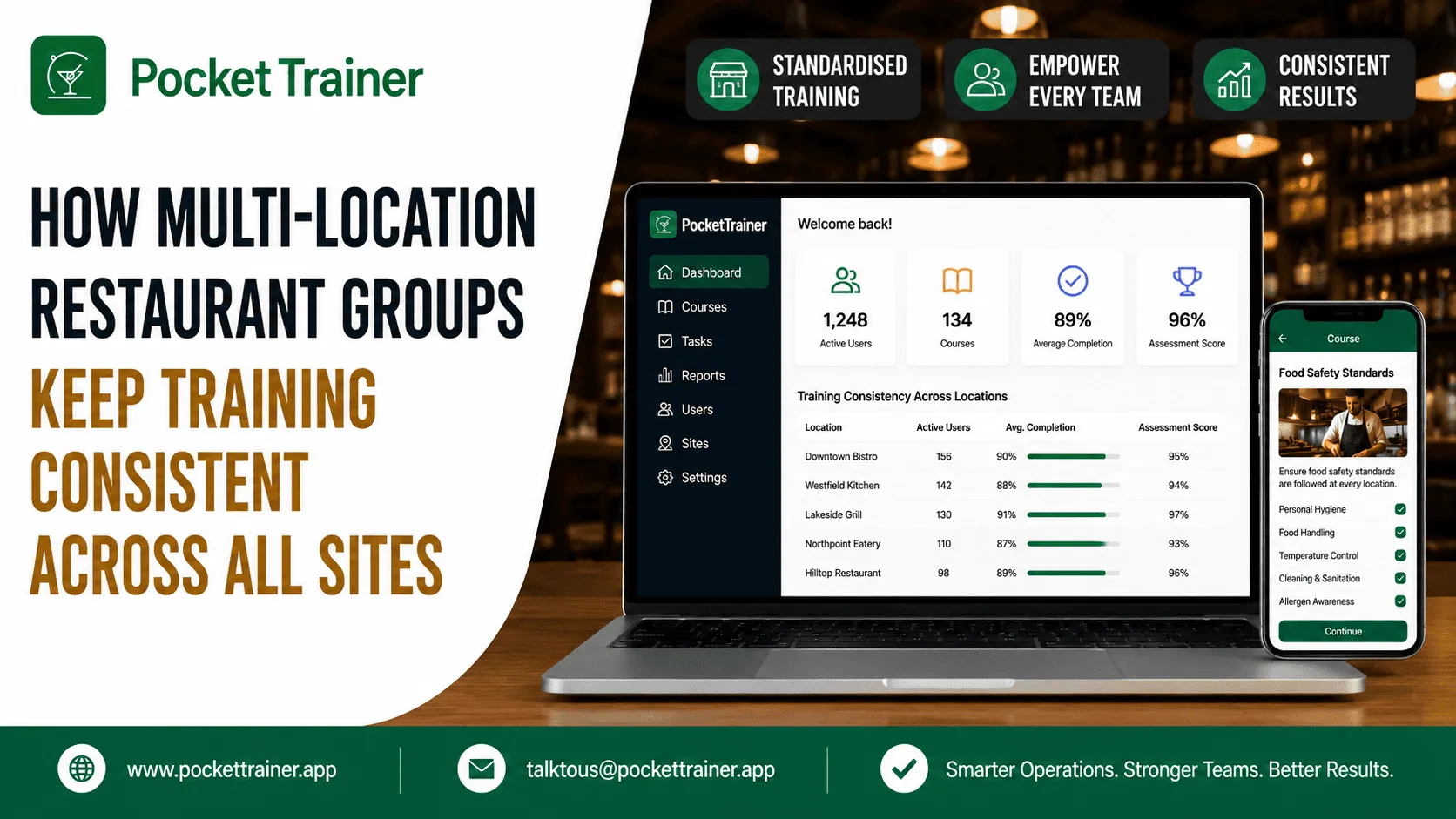
With a group’s data compiled in one dashboard, an administrator can select sites and departments and compare them directly. Completion data, cross-site comparison, department comparison, you select the sites or departments, then choose the data you want to monitor: courses, quizzes, training attendance, engagement, document and video open rates, login sessions, content created by management versus by the platform, mandatory versus optional, globally shared versus local.
You filter down to exactly what you need to see. That turns consistency from a hope into a measurement. A head office can see which sites are on top of their training and which are slipping, and act before the gap reaches a guest, rather than finding out when something goes wrong. This same reporting discipline is what underpins our guide to standardising training across locations more broadly.
The Takeaway
Multi-location groups keep training consistent by building an accountability model, not a vague sense of ownership: named responsibilities for content, users and completion KPIs, written down and handed to every new manager so the system survives turnover. New standards roll out cleanly when there is a clear goal, a deadline and time provided; most of the standard stays global with only F&B selection and local compliance flexing, and reporting is what proves every site is actually at level rather than assumed to be.
Consistency across sites is an operating discipline, and the groups that treat it as one are the ones whose fiftieth venue matches their first.
Want to build and test your team’s menu knowledge without the manual work?
Book a 15-minute demoWe will walk through it with your menu in mind. You can also read more about the digital food bible that holds your menu and the hospitality LMS behind it.
FAQs
1 What is workforce management for hospitality in a multi-site context?
Workforce management for hospitality across multiple sites means building a documented accountability model, not just deploying software, that defines who updates content, who manages users, and what completion is expected, so the training standard survives staff and management turnover regardless of which site or country a venue operates in.
2 How does multi-site training management differ from single-site training?
Single-site training can rely on a manager’s direct oversight and institutional memory. Multi-site training management requires the same standard to be written down, distributed, and measured across venues run by different people who never meet, which is why documented responsibility and centralised reporting become essential rather than optional.
3 Does every part of a training standard need to be identical across all locations?
No. Core elements like SOPs, service standards and handbooks are typically the same everywhere and only need to be created once, while F&B selection and certain compliance requirements genuinely flex by local market. The goal is holding the global core constant while allowing only the parts that need to differ to differ.
4 How do you roll out a new menu or SOP across every location at once?
Successful rollouts set an explicit goal, prepare content in advance, give a clear completion deadline, and give managers dedicated time to execute rather than adding it to an already full day. The most common failure is skipping the goal and timeline entirely, which leaves adoption to chance.
5 Can a restaurant group actually measure whether every site is meeting its training standard?
Yes, with centralised reporting that lets head office filter by site, department or region and compare completion, engagement and content activity directly. This turns training consistency from an assumption into something a head office can verify and act on before a gap in one location affects the guest experience.