
Who Owns Training Content on a Learning Platform?
By Janos Laszlo
- training content ownership
- learning platform content
- LMS content ownership
Quick Summary
- Separate vendor content, customer content, and vendor-built content.
- Get ownership terms in the contract, not just in an email.
- Ask what content you can export and in which format.
- Check what happens to your content when the contract ends.
- If your team creates it, make sure the agreement clearly addresses your rights to it.
Your head chef writes a preparation method. Your bar manager photographs a new cocktail. Your operations team documents a service sequence.
Over time, those pieces become more than training material. They become part of how your business operates.
That makes one question important when choosing a training platform: who owns the content your team creates, and what happens to it if you leave?
The answer should be clear before you sign a contract, particularly when your business is building its own menus, procedures, brand standards, videos, and training materials inside the platform.
Why should you check content ownership before choosing a training platform?
During a software evaluation, you are usually thinking about whether the platform works.
Will the team use it? Can it handle allergens properly? Can a manager pull a completion record?
Ownership can feel like a legal detail to sort out later.
Then two or three years pass.
Your team has built something genuinely useful: dishes with ingredients and preparation methods, wine lists with tasting notes, opening and closing procedures, induction content and videos showing your own chefs doing things correctly.
That is no longer just a training library. It can become an operating resource for the business.
The question of who owns it is therefore worth settling at the start, when the commercial relationship is being agreed.
“The cocktail guide. If we create a new cocktail I take a picture on the spot, I upload all the information, staff gets notified instantly.” - Sany Bacsi, Global Bar Manager, COYA
Do that regularly over several years and the amount of customer-created material can become substantial.
Who owns training content created by a business on an LMS?
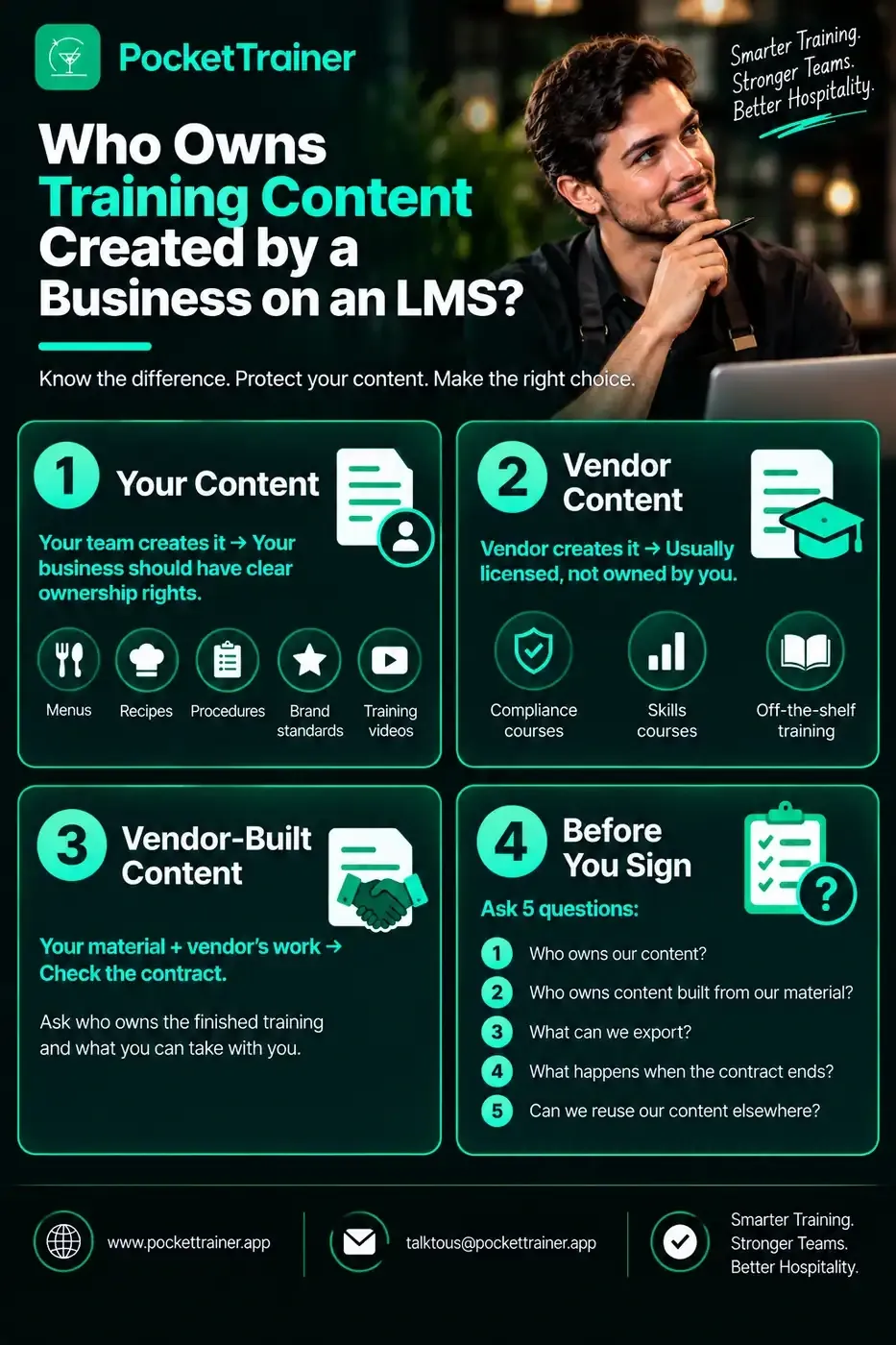
It depends on the contract, which is why the question needs to be asked before you sign.
A useful starting point is to separate:
- Content your business creates
- Content the vendor already owns
- Content the vendor creates from your source material
Your menus, standards, procedures, and videos created by your team should be addressed explicitly in the agreement.
The vendor’s own course library is different. You are generally licensing access to content created by the vendor rather than acquiring ownership of it.
The more complicated area is content the vendor builds using your material. For example, you provide menus and procedures, and the vendor turns them into structured training modules.
Ask who owns the resulting material and what you can take with you if the relationship ends.
Ownership and export rights should be discussed together.
The Three Kinds of Content in Your Account
Almost every ownership conversation becomes clearer when these three categories are separated.
1. The Vendor’s Course Library
These are off-the-shelf compliance and skills courses produced by the training provider.
You generally licence access to them for the term of your agreement. They remain the vendor’s content.
For hospitality businesses looking for ready-made compliance training, Pocket Trainer provides a hospitality course library covering areas such as food safety, HACCP, health and safety, and fire warden training.
2. Content the Vendor Builds From Your Material
You provide your menus, standards, procedures, photographs, or other source material, and the vendor’s team turns that material into structured training.
Your source material is yours. The important contractual question is who owns the resulting built version.
This is the category to ask about specifically rather than assuming the answer.
3. Content Your Team Creates in the Platform
This could include:
- Brand standards
- Recipes
- Service procedures
- Site-specific processes
- Training videos
- Product information
The agreement should clearly state how this customer-created content is treated.
“I see Pocket Trainer as really a very helpful tool for us because we are multi-brand, first and foremost. Multi-brands, you have the tendency to have your own brand standards, and you have to customise it as per the venue. And, it’s not like the traditional, one-size-fits-all, unfortunately, and this is why it’s helping us a lot. And the ability obviously to reach out to all the audience in different countries, so it’s readily available, 24/7, it’s cloud based, and it’s really helpful for us, especially for myself because I would not be able to travel a lot, you know, in one week, but I’ll be able to see the progress of training, through the system.” - Melanie Ortiz, Group HR Director, Bulldozer Group
For multi-brand operators, venue-specific standards can quickly become a significant body of operational content.
What to Ask, and What a Good Answer Sounds Like
Five questions are worth asking in writing before signing.
1. Who Owns Content Our Team Creates in the Platform?
A clear answer should identify the customer’s rights to its own material.
Avoid relying on vague statements about “your content” without asking what that specifically includes.
2. Who Owns Content You Build for Us From Our Material?
Ask specifically about the structured training created from your menus, standards, procedures, and other source material.
This is often where the ownership position needs the most clarification.
3. What Can We Export, and in What Format?
There is a meaningful difference between:
- A file another system can import
- A collection of documents
- A report
- Content that can only be viewed inside the platform
Ask for the actual export format rather than simply asking whether “export” is available.
4. What Happens to Our Content When the Contract Ends?
Ask:
- How long is content retained?
- Can you retrieve it after termination?
- Is there a retrieval period?
- Is there a charge?
Get the answer in writing.
5. Can We Use Our Own Content Outside the Platform?
Your business may want to use its own material for a printed induction pack, training session or new site opening.
Understand whether your agreement allows this and whether there are any restrictions.
“My favourite is the food guide, since I’m very passionate of the recipes of the food we serve. We are kind of food ambassadors as well of the restaurant, so we need to know exactly what we deliver to the table, how it gets prepared, where it comes from. So the fact that on Pocket Trainer there is all this access to all this information, it’s very nice.” - William Mc Inally, Floor Manager, LPM Dubai
Recipes, preparation methods and provenance can form an important part of a hospitality business’s operational knowledge, so their contractual treatment is worth establishing early.
Bring your own content and see how it works:
Book a 15-minute demoWhich contract clauses should you check for training content ownership?
Four areas of the agreement are worth checking, whether you are signing something new or reviewing an existing contract.
The Intellectual Property Clause
Look for a clear distinction between vendor content and customer content.
If the agreement defines the vendor’s intellectual property but does not clearly address your own content, ask for clarification.
The Licence You Grant the Vendor
A platform needs appropriate rights to host, display and process your content as part of delivering the service.
Check what the licence covers, how broad it is and how long it lasts.
The Termination Clause
Check what happens to your content on the final day of the agreement.
Look for information about retrieval, retention periods, and any applicable process or restrictions.
Aggregated or Derived Data
Some agreements address aggregated or derived information separately.
If this appears in the contract, establish what is being derived from your content and whether the information can identify your business, employees, or other individuals.
None of this requires you to turn the software evaluation into a legal exercise. It does require you to identify the relevant clauses and ask questions where the wording is unclear.
Content Ownership Checklist for Training Platforms
Before signing, make sure you can answer these six questions:
- Who owns our content?
- Who owns content built from our material?
- What can we export?
- Which export formats are available?
- What happens when the contract ends?
- Can we reuse our content elsewhere?
How Pocket Trainer Approaches It
The Platform Is Built Around Your Content
The digital food, cocktail and wine bible, your standards and your service sequences are central to the Pocket Trainer platform, rather than simply being an add-on to a stock course catalogue.
For established hospitality businesses, much of the useful operational content will naturally come from the customer.
Our Position Is Stated Plainly
An operator who creates its own content should have clear rights to that material.
If your chef writes the preparation method and your bar manager creates the video, ask the training vendor to explain exactly how that material is treated under the agreement.
We Build Your Starting Content From What You Send
Pocket Trainer can take existing material and turn it into structured training through custom content creation.
This can help businesses move existing menus, procedures, and other training material into the platform without requiring them to create everything from scratch.
Your Team Can Maintain the Content
A chef can update a dish. A bar manager can add a cocktail. The team can keep operational information current within the platform.
That makes customer-created content an ongoing part of the training environment rather than a one-time upload.
Managers Can Access Training Reporting
Managers can access reporting through training management, while staff can access their training and completion records.
Scope, So You Can Rule Us Out Quickly
Scheduling, time and attendance, and employee net promoter surveys are not part of the platform.
Understanding what a platform does not provide is just as important as understanding what it does.
Final Thoughts
Content ownership is easy to overlook when you are focused on features, usability, and adoption.
But menus, recipes, procedures, brand standards and training videos can become valuable operational resources over time.
Before choosing a training platform, separate vendor content from your own content, ask who owns anything built from your material, and understand exactly what you can export if the relationship ends.
Most importantly, get the answers into the contract rather than relying on informal assurances.
Bring your own compliance requirement and ask to see the completion record produced live, filtered by site and role.
Book a 15-minute demoFrequently Asked Questions
Is this a real risk or a theoretical one?
It is a practical contractual question that can become important when you change platforms, restructure your business, or want to reuse your own training material elsewhere.
Does the vendor need any rights to our content at all?
A platform may need appropriate rights to host, display and process your material while providing the service. Check what those rights cover, how broad they are and what happens when the agreement ends.
We are already two years into a contract. Is it too late?
Not necessarily. Review the relevant intellectual property, licence, termination, and data-related clauses. If the position is unclear, renewal can be a practical opportunity to clarify the agreement.
What if the vendor built most of our content?
Ask who owns the completed material and what you can retrieve if you leave the platform. The answer should be established from the contract rather than assumed.
Can we use our training content outside the platform?
That depends on the agreement and the rights attached to the material. Ask specifically whether your own content can be reused for induction packs, training sessions, or other business purposes.