
What Traditional Restaurants Can Learn from Ghost Kitchens
By Janos Laszlo
- ghost kitchens
- traditional restaurants
- ghost kitchen restaurant
- cloud kitchen
- virtual restaurant
- restaurant delivery
- restaurant technology
- virtual brands
- restaurant staff training
- hospitality training
- restaurant operations
- food delivery
Quick Summary
- Ghost kitchens focus on delivery and takeaway without traditional dining areas.
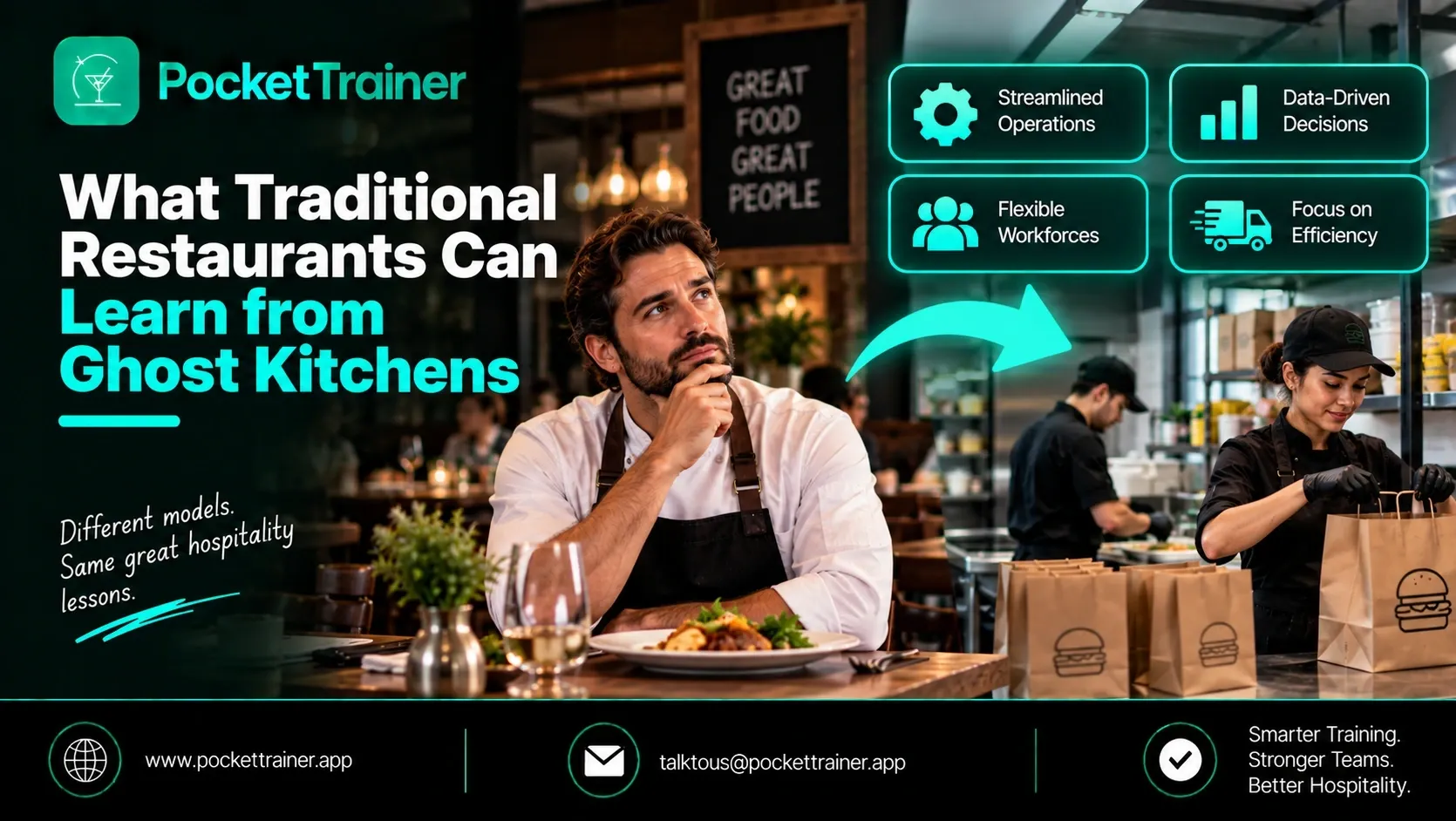
- Traditional restaurants can learn from ghost kitchens through technology, delivery, and operational efficiency.
- Virtual brands allow restaurants to test new concepts using existing kitchen facilities.
- Staff training, food safety, and consistent customer experience are essential for growth.
The way people discover, order and enjoy food has changed significantly over the past few years. The growth of delivery, online ordering and virtual restaurant concepts has challenged traditional restaurants to rethink how they operate beyond the dining room.
Ghost kitchens, also known as cloud kitchens or virtual kitchens, have become part of this shift. By focusing primarily on delivery and takeaway, these businesses can operate without a traditional customer-facing dining area.
For traditional restaurants, the lesson is not necessarily to become a ghost kitchen. It is to understand which parts of the model can improve efficiency, flexibility, delivery and customer reach while protecting the restaurant’s existing brand and service experience.
What Is a Ghost Kitchen and How Does It Work?
A ghost kitchen, cloud kitchen or dark kitchen is a professional cooking space designed primarily to prepare food for delivery or takeaway, usually without a traditional customer-facing dining room.
The model became particularly visible during the COVID-19 pandemic as restaurants and consumers adapted to changes in dining and ordering behaviour. Since then, delivery-focused operations and virtual restaurant brands have remained an important part of the wider foodservice landscape.
The global ghost kitchen market was estimated at US$70.37 billion in 2023 and one market research forecast projected it could reach US$156.60 billion by 2030, representing a 12.1% CAGR. Because market estimates vary between research providers, this figure is best treated as a market forecast rather than a definitive measure of the entire industry.
Ghost Kitchens vs. Traditional Kitchens
The biggest difference between ghost kitchens and traditional restaurants is their operational structure.
Traditional restaurants need to manage a customer-facing dining environment alongside food preparation, including front-of-house staffing, tables, service and the overall in-person experience.
Ghost kitchens focus primarily on food production, order management, packaging and delivery. This allows operators to design processes around off-premise orders rather than dining-room service.
The difference does not automatically make one model better than the other. Instead, it highlights different operational priorities.
For example, a traditional restaurant may need to balance:
- Dining-room capacity
- Front-of-house service
- Kitchen production
- Takeaway and delivery
- Customer experience
A delivery-focused kitchen can concentrate more heavily on:
- Order volume
- Preparation speed
- Packaging
- Delivery handover
- Online customer experience
Virtual brands can also operate from existing restaurant kitchens. MrBeast Burger, for example, was launched as a virtual brand using partner restaurants, and Restaurant Business reported that it had more than 1,700 outlets and had passed $100 million in revenue by July 2022.
This illustrates one important lesson for traditional restaurants: an existing kitchen can potentially support more than one customer-facing concept.
Why Are Ghost Kitchens Succeeding?
There are several reasons why ghost kitchens have attracted restaurant operators and food entrepreneurs.
1. Lower Overhead Costs
Without a traditional dining room, a delivery-focused operation may avoid some of the costs associated with customer-facing space, including dining-room fit-out and front-of-house operations.
However, this does not mean ghost kitchens are automatically cheaper to run. Delivery commissions, packaging, technology, marketing, kitchen equipment, labour and food costs still need to be managed carefully.
2. Flexibility and Adaptability
Ghost kitchens can make it easier to test different menus, concepts and customer segments.
A restaurant with spare kitchen capacity could potentially test a delivery-only menu or virtual brand without creating an entirely separate physical restaurant.
This can give operators a way to experiment with new concepts while using existing resources.
3. Operational Efficiency
Because ghost kitchens are designed around delivery and takeaway, their processes can be structured around order preparation, packaging and handover.
For traditional restaurants, the lesson is not simply to copy the ghost kitchen model. It is to identify where processes can be simplified, standardized or supported by technology.
Bring your own compliance requirement and ask to see the completion record produced live, filtered by site and role.
Book a 15-minute demoWhat Can Traditional Restaurants Learn From Ghost Kitchens?
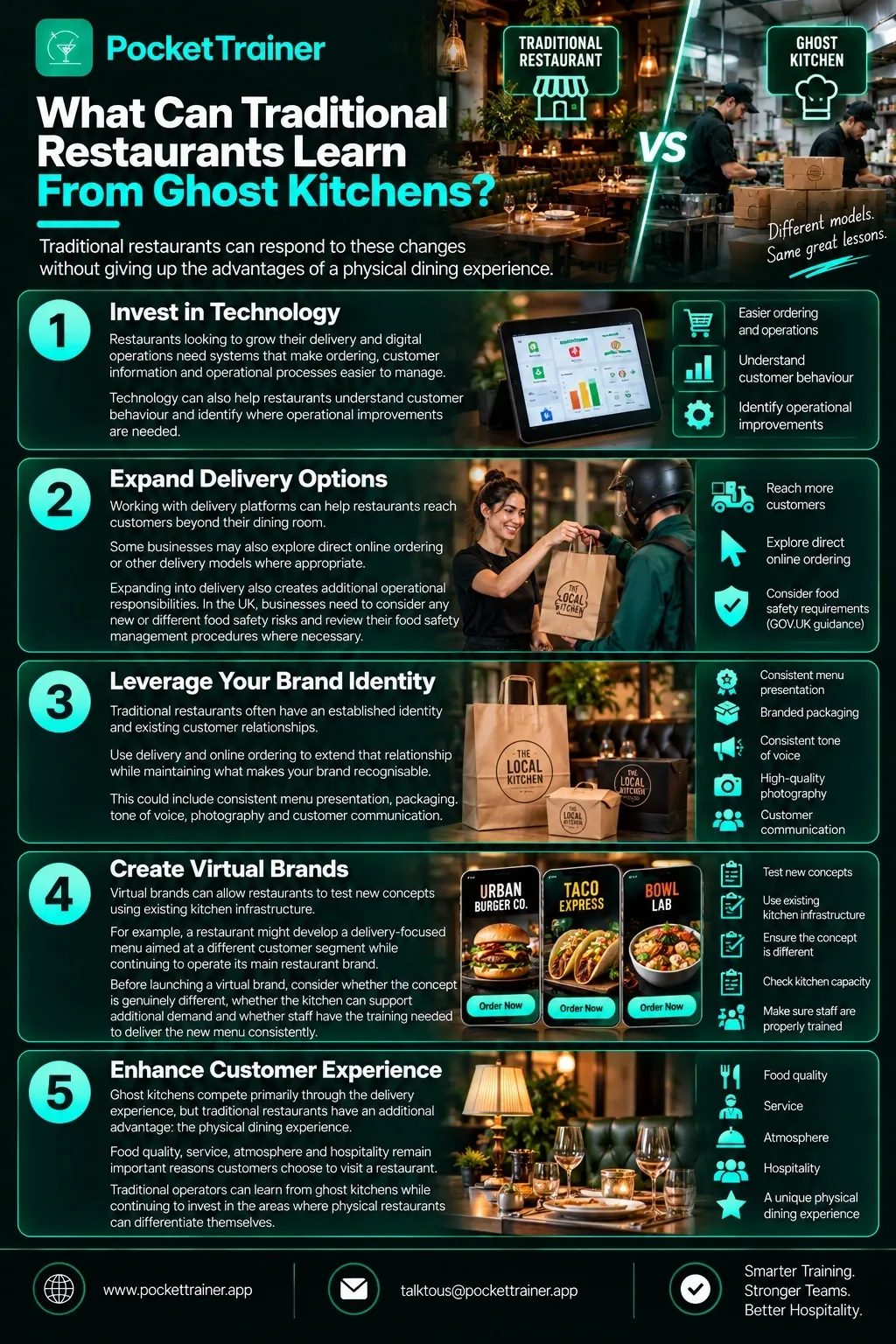
Traditional restaurants can respond to these changes without giving up the advantages of a physical dining experience.
1. Invest in Technology
Restaurants looking to grow their delivery and digital operations need systems that make ordering, customer information and operational processes easier to manage.
Technology can also help restaurants understand customer behaviour and identify where operational improvements are needed.
2. Expand Delivery Options
Working with delivery platforms can help restaurants reach customers beyond their dining room.
Some businesses may also explore direct online ordering or other delivery models where appropriate.
However, expanding into delivery also creates additional operational responsibilities. In the UK, businesses moving into food delivery need to consider any new or different food safety risks and review their food safety management procedures where necessary. GOV.UK food delivery guidance
3. Leverage Your Brand Identity
Traditional restaurants often have something that a new virtual brand does not: an established identity and existing customer relationships.
Restaurants can use delivery and online ordering to extend that relationship while maintaining the characteristics that make the brand recognisable.
This could include consistent menu presentation, packaging, tone of voice, photography and customer communication.
For more on building a restaurant brand, see Building a Strong Restaurant Brand Identity on Social Media.
4. Create Virtual Brands
Virtual brands can allow restaurants to test new concepts using existing kitchen infrastructure.
For example, a restaurant might develop a delivery-focused menu aimed at a different customer segment while continuing to operate its main restaurant brand.
Before launching a virtual brand, operators should consider whether the concept is genuinely different, whether the kitchen can support additional demand and whether staff have the training needed to deliver the new menu consistently.
5. Enhance Customer Experience
Ghost kitchens compete primarily through the delivery experience, while traditional restaurants have an additional advantage: the physical dining experience.
Food quality, service, atmosphere and hospitality remain important reasons customers choose to visit a restaurant.
Traditional operators can therefore learn from ghost kitchens while continuing to invest in the areas where physical restaurants can differentiate themselves.
What Should Restaurants Check Before Expanding Into Delivery?
Before adding delivery or a virtual brand, restaurant operators should consider:
- Can the existing kitchen handle additional orders?
- Does the menu travel well?
- Are packaging requirements clear?
- Is allergen information accurate across online menus and delivery channels?
- Are staff trained to handle delivery and allergen-related requests?
- Does the food safety management system reflect the delivery operation?
- Can the restaurant maintain the same food and service standards at higher order volumes?
In the UK, allergen information for takeaway and delivery food must be provided at relevant stages of the ordering and delivery process. GOV.UK allergen guidance explains the requirements, while the Food Standards Agency provides additional guidance for businesses handling allergens and delivery.
Take Your Restaurant to the Next Level With the PocketTrainer App
As restaurants expand across physical dining, delivery and virtual concepts, consistent staff training becomes increasingly important.
PocketTrainer helps hospitality businesses organise training digitally, giving employees access to relevant training materials and helping operators maintain consistency across teams and locations.
The platform can support areas such as onboarding, operational knowledge and role-based hospitality training through a centralised digital system.
Explore the Pocket Trainer hospitality LMS to see how digital training can support restaurant teams.
For businesses that need training built around their own menus, procedures or brand standards, custom training content can also help turn existing operational knowledge into structured learning.
How Training Supports Restaurant Growth
Adding delivery, virtual brands or additional locations can increase operational complexity.
Employees may need to understand new menus, packaging procedures, allergen information, customer communication and brand standards.
This makes consistent training particularly important when restaurants are trying to scale.
A digital training system can give operators a central place for training content while helping managers understand whether required learning has been completed.
For restaurants managing multiple locations, this can also make it easier to keep operational information consistent.
Train Smarter, Serve Better
Ghost kitchens have demonstrated how much restaurant operations can change when businesses design around technology, delivery and customer convenience.
Traditional restaurants do not need to become ghost kitchens to learn from the model.
Instead, they can take the useful lessons: make better use of technology, simplify operational processes, explore delivery opportunities, test new concepts carefully and maintain a consistent customer experience.
The restaurant industry will continue to evolve, but the fundamentals remain important: good food, efficient operations, trained teams and a strong relationship with customers.
Final Thoughts
Ghost kitchens have shown traditional restaurants that the kitchen can be more than a place that serves the dining room. It can also support delivery, new concepts and additional customer channels.
The opportunity for traditional restaurants is to take those lessons selectively. The strongest approach will depend on the restaurant’s brand, kitchen capacity, customer base, delivery strategy and operational model.
Technology can help, but it works best when it is supported by clear processes and well-trained teams.
Bring your own compliance requirement and ask to see the completion record produced live, filtered by site and role.
Book a 15-minute demoFrequently Asked Questions
What is a ghost kitchen?
A ghost kitchen is a professional food preparation facility designed primarily for delivery or takeaway, usually without a traditional customer-facing dining room.
Are ghost kitchens cheaper than traditional restaurants?
They can avoid some costs associated with customer-facing dining space, but they still have expenses such as labour, food, packaging, technology, marketing and delivery. Cost savings therefore depend on the individual business model.
Can a traditional restaurant create a virtual brand?
Yes. A traditional restaurant can potentially use its existing kitchen to operate a delivery-focused virtual brand. The operator should first assess kitchen capacity, menu suitability, delivery economics, branding and staff training.
What should restaurants consider when adding food delivery?
Restaurants should consider food safety, allergen information, packaging, delivery processes, menu suitability, order management and staff training. UK food delivery guidance also recommends reviewing food safety procedures when a business introduces delivery.
Does restaurant staff training matter when adding delivery or virtual brands?
Yes. New menus, procedures, allergen requirements, packaging processes and customer interactions can create additional training needs. Consistent training can help teams understand the operational standards expected from the business.