
Training Platform Integrations: Rota, HR, SSO & POS
By Janos Laszlo
- training platform integrations
- hospitality software integration
Quick Summary
- Integrations depend on both systems and both vendors, not just the training platform.
- Confirm the data, cost, ownership, and maintenance before agreeing to an integration.
- Rota, HR/payroll, and single sign-on can solve practical problems, but not every integration is necessary.
- Ask for a live customer reference, not just a vendor capability statement.
- If a simple spreadsheet import solves the same problem, it may be the more practical option.
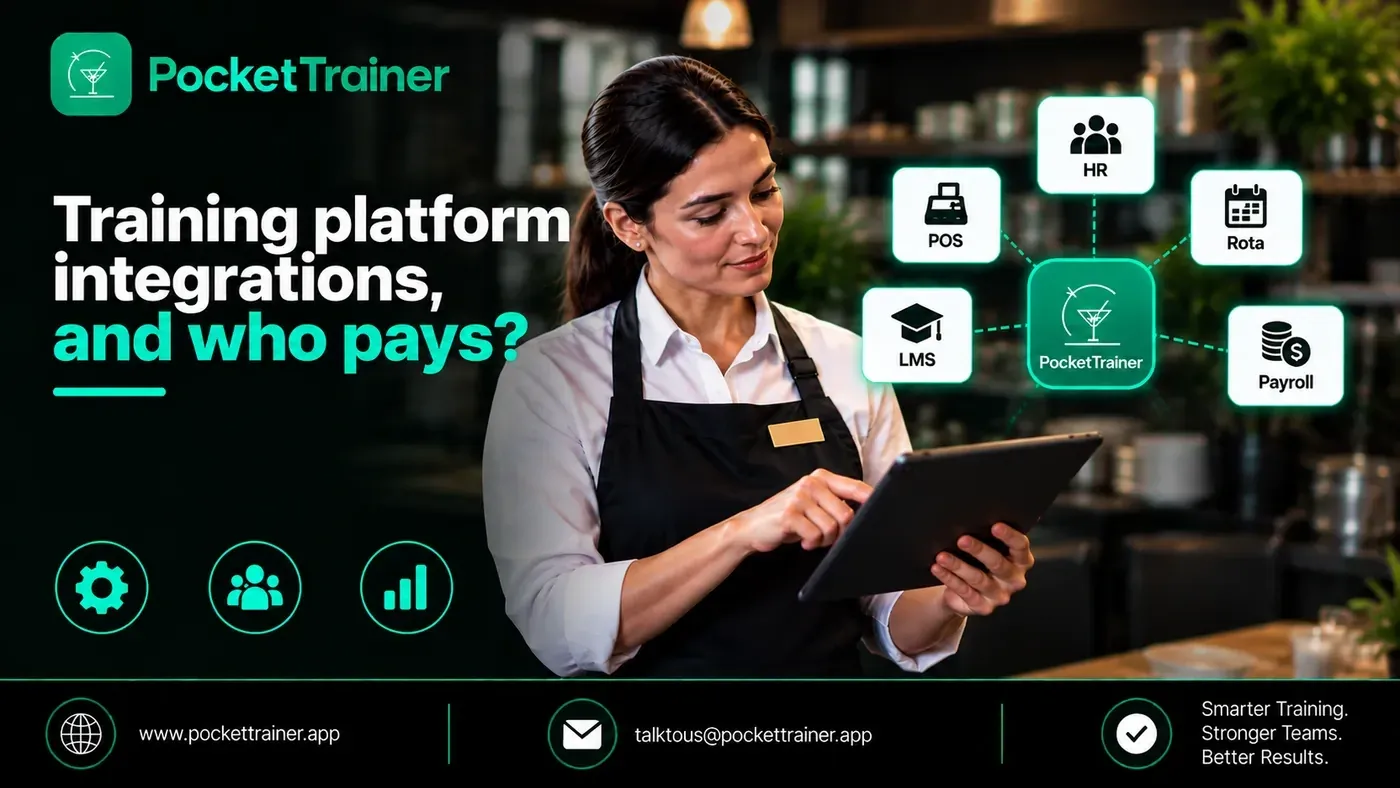
Training platforms rarely operate in isolation. Hospitality businesses often already have rota software, HR systems, payroll platforms, or other operational tools, which naturally raises a question: who pays when those systems need to connect?
The answer is rarely as simple as asking whether a training platform “integrates” with another system. The real questions are what data needs to move, which system owns that data, who builds the connection, and who maintains it when either platform changes.
For hospitality operators, understanding those details before signing a contract can prevent unexpected costs and avoid paying for integrations that do not materially improve the operation.
Why a Yes From One Vendor Means Very Little
Every integration has two ends. Your training platform can have a perfectly good API and still be unable to connect to your rota system because the other system may have no API, require a paid API tier, use a different data model, or support a version that your group has not adopted.
That is why “yes, we integrate with that” is not enough information to make a buying decision.
The useful answer has four parts:
- Which specific product and version?
- Which direction does the data move?
- Which fields are transferred?
- Who builds and maintains the connection?
A vendor asking these questions is not necessarily making the process difficult. It can indicate that they are trying to establish whether the proposed connection is technically and commercially realistic.
Do Hospitality Training Platforms Integrate With Rota and HR Systems?
Often, they can, but the answer depends on both systems rather than the training platform alone.
The other product needs an accessible way to exchange data, which may depend on its API capabilities or subscription tier. The two systems also need to agree on how they identify a person, site, and role.
Integration work may also be quoted separately as professional services rather than being included in the software licence.
Before scoping an integration, ask what decision the shared data would actually change. If the main benefit is simply avoiding occasional manual user setup, a CSV import may provide a more proportionate solution.
For businesses that need structured employee training, Pocket Trainer provides a dedicated hospitality LMS rather than trying to replace every workforce management function.
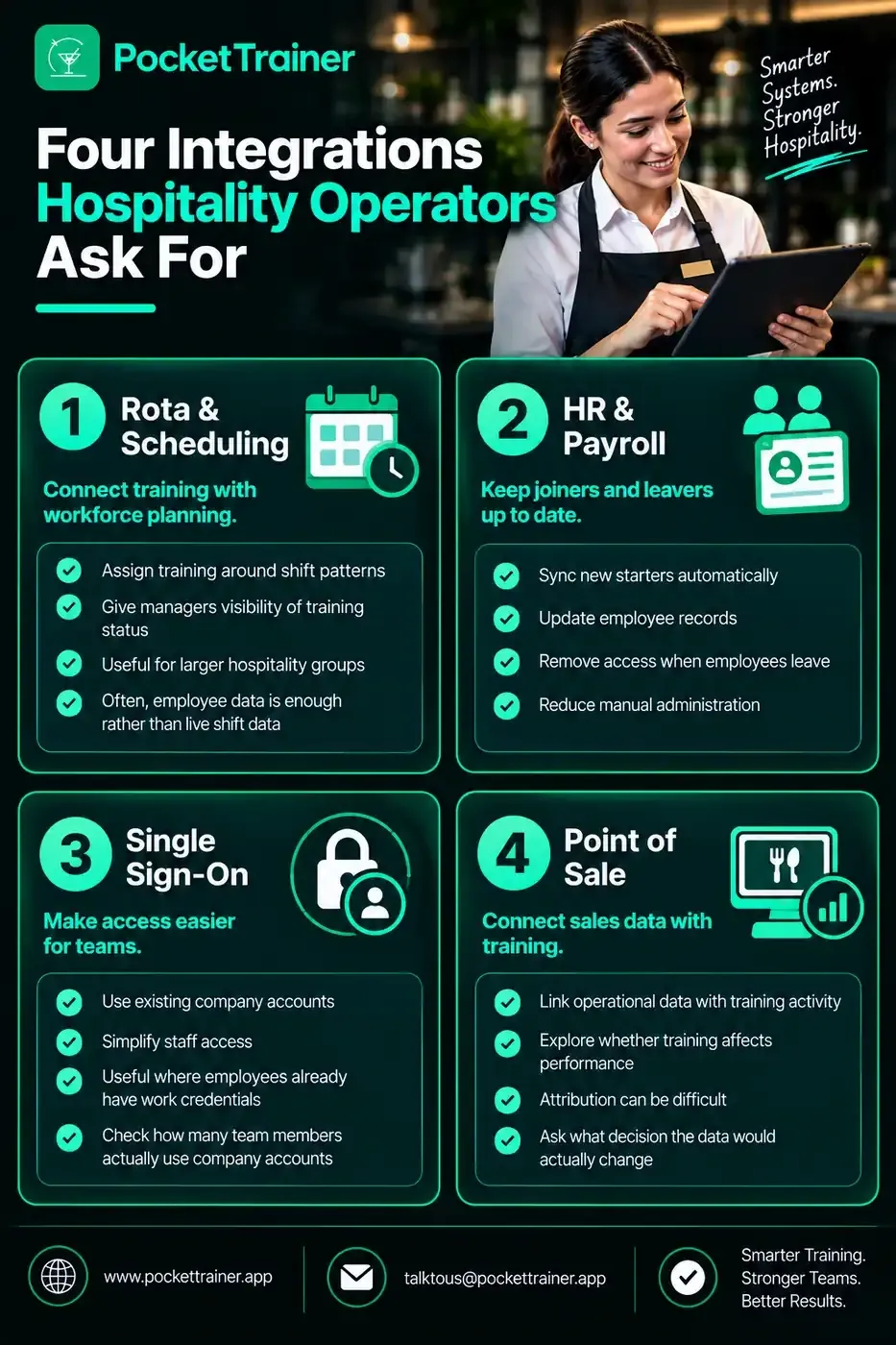
The Four Integrations Operators Ask For
Rota and Scheduling
Rota integrations are usually requested so training can be assigned around shift patterns, or so managers can see training status alongside workforce information. This can be useful at scale, particularly where employee information needs to move between systems.
However, not every business needs live shift data. In some cases, synchronising employee records, sites and roles is enough.
HR or Payroll
HR or payroll integration can have a clear operational use because it can help manage joiners and leavers.
For example, a new starter appearing automatically in the training platform can reduce manual administration, while removing access when someone leaves can support access control.
The exact value depends on how the organisation currently manages employee records.
Single Sign-On
Single sign-on can make sense when employees already use company-managed accounts across other systems.
Hospitality businesses should first establish how many employees actually have company credentials. If only managers have work accounts, the value of organisation-wide SSO may be more limited.
Point of Sale
POS integration is often attractive because operators want to connect sales information with training activity. The challenge is determining what the resulting data actually proves.
For example, attributing a change in average spend to one specific training module can be difficult because menu changes, pricing, seasonality, staffing, and other operational factors may also affect the result.
Before paying for a POS integration, ask what you would actually do differently if you had the data.
“Since we implemented Pocket Trainer we have many processes that now can be done from your phone, and the onboarding experience of the candidate is much smoother now.” - Tomas Vega, Regional Training Manager, LPM
The example is useful because not every operational improvement requires a new system-to-system integration.
What It Actually Costs, and Who Pays
Three things should be established in writing before signing an integration agreement.
Is the Integration Included in the Licence?
Do not assume that an integration is included simply because it appears on a vendor’s list of supported integrations.
Ask whether the connection is included in the licence, requires professional services, or involves additional implementation charges. Where two vendors are involved, both may have separate commercial requirements.
Does the Other System Charge for API Access?
Some business software products restrict API access to particular subscription tiers.
That additional cost may sit with the customer, so it should be included in the total implementation budget rather than discovered later.
Who Maintains the Integration?
An integration does not necessarily end when the initial build is complete.
APIs, software versions, and data structures can change. Ask what happens if the connection stops working after an update and which party is responsible for investigation, fixes, and ongoing maintenance.
The practical way to think about it is simple:
An integration is a small project, not just a feature.
Treating it as a checkbox in a software comparison can leave important costs and responsibilities unclear.
“They are very advanced with technology, everyone’s literally attached to their phones.” - Alexandra Malkova, Head of Reservations, COYA Dubai and COYA Abu Dhabi
If you are being quoted for integrations you are not sure you need, bring the list to
Book a 15-minute demoWe will work through which ones may be unnecessary for your operation.
How to Scope One Properly
Five questions should be answered in this order, ideally with both vendors involved.
1. What Decision Changes Because of This Data?
If nobody can name a decision that changes because of the integration, stop and reconsider the requirement.
The purpose of an integration should be more than simply having two systems connected.
2. Which Direction Does the Data Move, and Which Is the Source of Truth?
Two systems both treating themselves as the owner of the same employee record can create unnecessary complexity.
Establish which system is authoritative for each type of information.
3. What Is the Minimum Field List?
A starting list might include:
- Name
- Employee ID
- Site
- Role
- Start date
- End date
Only add fields when there is a clear operational reason for doing so.
Every additional field can add scope to the integration.
4. How Often Does It Need to Sync?
Ask whether the business genuinely needs real-time information.
For employee records, a scheduled sync may be sufficient in many situations. The appropriate frequency should be based on the operational requirement rather than assumed in advance.
5. Who Do We Call When It Breaks?
Get a clear support route from both sides.
Ask:
- Who owns the integration?
- Who investigates failures?
- How are issues escalated?
- Are fixes included in the agreement?
“It’s very comfortable, very simple. For me, it’s a new era.” - Anastasiia Kachalenko, Receptionist, MIYA, Bulldozer Group
If a proposed integration cannot provide a clear answer to these questions, consider whether a simpler data exchange method could achieve the same operational outcome.
Should We Pay for a POS Integration With Our Training Platform?
Rarely, unless you can state precisely what you would do differently with the linked data.
A common rationale is to demonstrate whether training influenced sales performance. However, attributing a sales change to one specific training module can be difficult because menu changes, pricing, seasonality, staffing, and other factors may also influence results.
A lower-complexity approach may answer some training questions without a POS integration. For example, operators can use knowledge checks before and after a menu change and compare completion and knowledge results across sites.
The important question is not whether the integration is technically possible. It is whether the resulting information changes an operational decision.
What Pocket Trainer Will and Will Not Promise
We Will Scope, Not Promise
Integrations depend on both parties and on the capabilities of the other system.
Where an integration requires additional work, it may be treated as a paid professional service. The important point is to establish that scope before implementation rather than treating an integration as automatically included.
What Needs No Integration at All
Content, courses, and the digital food, cocktail, and wine bible can be managed directly inside the Pocket Trainer platform.
Completion records can be filtered by site and role through training management without requiring an external system.
Pocket Trainer can also support businesses that need help getting their training content ready. The team can build and upload custom training content during onboarding.
For compliance-focused training, businesses can also explore the hospitality course library, which covers areas such as food safety, HACCP, health and safety, and fire warden training.
Where We Are Not the Answer
Scheduling, time and attendance, and employee net promoter surveys are not part of the platform.
If the reason you want a rota integration is that you actually need a rota or workforce management system, that should be addressed directly rather than expecting a training platform to solve the underlying requirement.
Final Thoughts
Training platform integrations can be useful, but the technology should follow the operational requirement, not the other way around.
Before paying for a connection, establish what data needs to move, which system owns it, who pays for access and implementation, and who maintains the connection afterwards.
For many hospitality operators, a simple employee-data exchange may solve the actual problem without the cost and complexity of a larger integration project.
If an integration does not change a decision, improve administration, or address a clear operational requirement, it is worth questioning whether you need it at all.
Bring your own compliance requirement and ask to see the completion record produced live, filtered by site and role.
Book a 15-minute demoFAQs
Can we just import a spreadsheet?
Yes. For some hospitality businesses, a scheduled CSV or spreadsheet import may provide enough information without requiring a full system integration. The appropriate approach depends on the data involved and how frequently it needs to change.
What if our other vendor says no?
Then the proposed integration cannot proceed as planned. Establish compatibility with both vendors early, rather than relying only on the training platform’s integration capabilities.
Does single sign-on matter if staff have no work email?
Its value may be limited if most employees do not have company-managed accounts. Check how many team members actually use company credentials before treating SSO as a requirement.
How long does a straightforward HR sync take?
There is no single timeframe that applies to every HR integration. Ask for a named customer reference where the same connection is already live and ask that customer about their implementation experience.