
How to Build a Restaurant Training Platform from Scratch (Even If You’ve Never Had One)
By Janos Laszlo
- restaurant training
- onboarding
- staff development
- compliance
- hospitality operations
Quick Summary
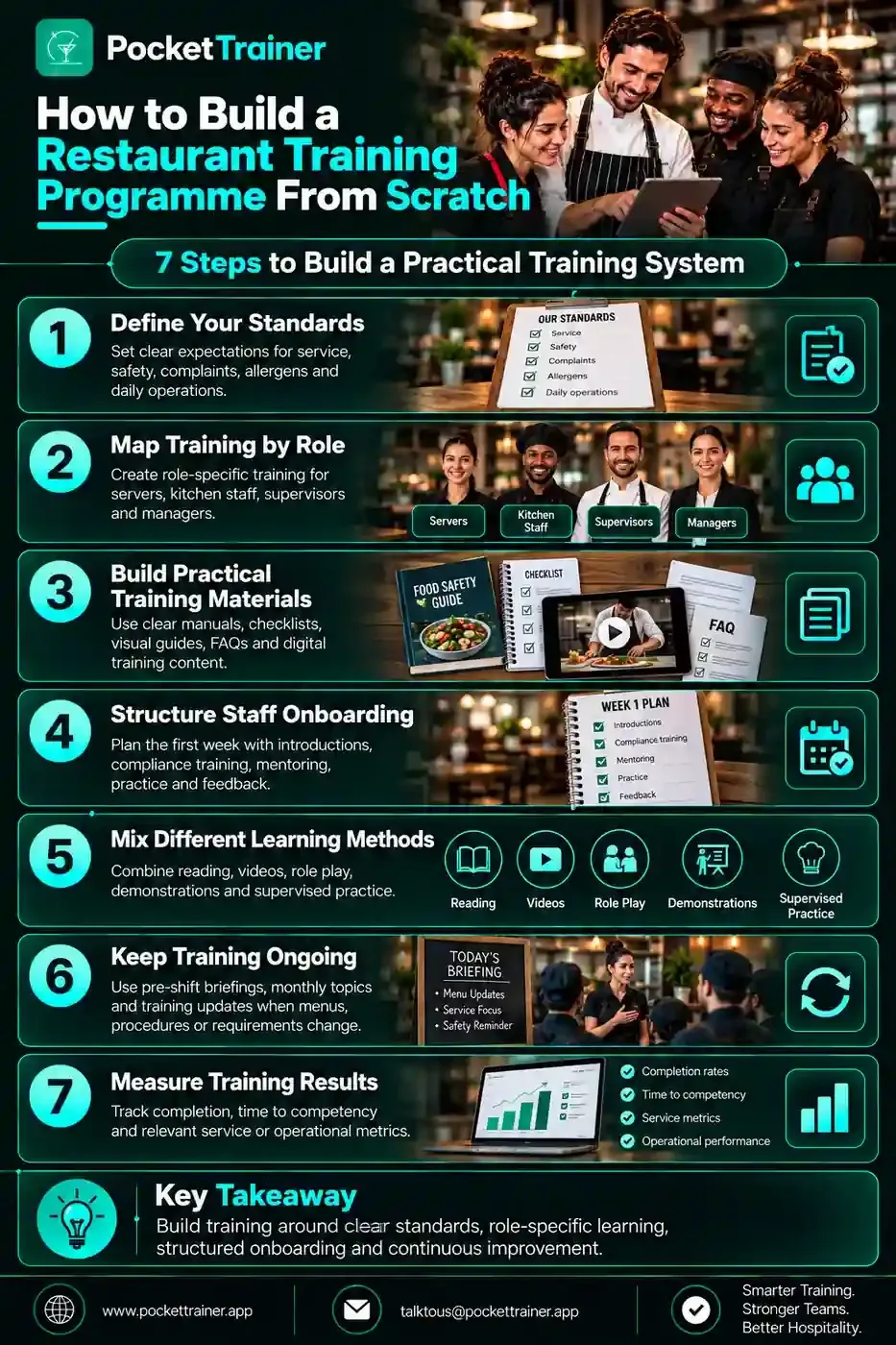
- Define clear standards: Set service, safety, and operational expectations before creating training.
- Train by role: Build different training paths for servers, kitchen staff, supervisors, and managers.
- Structure onboarding: Use a clear first-week process with shadowing, practice, feedback, and assessment.
- Use different learning methods: Combine reading, videos, practical training, and supervised practice.
- Keep training ongoing: Update training when menus, procedures, or operational requirements change.
- Measure results: Track completion, time to competency and relevant operational or service metrics.
- Use the right tools: A hospitality training platform can centralise content, onboarding and training records as your restaurant grows.
Most restaurants do not start with a formal training programme. Instead, training often develops informally through shadowing, printed documents and experienced team members showing new starters what to do.
That approach can work for a small team, but it becomes harder to maintain as the restaurant grows, staff change and operational standards evolve.
A structured restaurant training programme gives your team a clearer path from their first day to independent working. It can bring service standards, role-specific knowledge, onboarding, compliance training and ongoing development into one manageable system.
This guide explains how to build a practical restaurant training programme from scratch, whether you run one site or a growing restaurant group.
What Should Be Included in a Restaurant Training Programme?
A restaurant training programme should include documented service standards, role-specific training paths, a structured onboarding process, compliance training with tracked completion, ongoing development content, and a way to measure whether the training is working.
These elements create a clear framework for deciding what employees need to know, when they need to learn it, and how managers can check that the training has been completed.
Step 1: Define Your Standards Before You Train Anything
You cannot train people effectively if you have not decided what good looks like.
Before you write a single piece of training material, answer these questions:
- How do you want guests to be greeted when they walk in?
- What should a server say when they approach a table for the first time?
- How should complaints be handled?
- What are your standards for food presentation?
- What is your allergen communication process?
- How should tables be reset between covers?
These are your service standards. They are the foundation of everything that follows.
Without clear standards, training becomes vague guidance. With clear standards, training becomes something you can explain, practise, and measure.
Write them down in plain language your team will understand. Start with five to ten core standards and expand them as your operation develops.
Step 2: Map Roles to Required Knowledge
A common mistake is creating one generic training programme for everyone.
A server’s training needs are different from those of a kitchen porter, and both are different from the requirements of a shift supervisor or manager.
Start by listing every role in your operation. Then identify the core knowledge and skills required for each one.
- Server: menu knowledge including allergens, order-taking processes, upselling techniques, complaint handling, table setup and reset standards.
- Kitchen staff: food safety, recipe specifications and plating standards, stock rotation, cleaning schedules and HACCP procedures.
- Supervisors and managers: opening and closing procedures, cash handling, complaint escalation, scheduling and performance feedback.
This role-mapping exercise gives you the skeleton of your training programme. You know what to train, who needs it and in what order.
Step 3: Build Your Training Materials
Your training materials do not need to be a 200-page document.
The longer they are, the less likely people are to read them. What they need to be is clear, practical, and easy to reference during a shift.
A practical restaurant training manual can include:
- A welcome section covering your story and values
- Role-specific sections covering key tasks and standards
- Visual references showing table setups or dish presentation
- Quick-reference cards for allergens
- Daily checklists
- A short FAQ covering common questions from new starters
Digital training materials can make it easier to update, distribute, and track learning than paper-based manuals.
When a menu or procedure changes, a digital module can be updated and assigned without relying on old printed copies being removed from circulation.
PocketTrainer’s AI-powered course creation tool can help managers build custom training modules without technical knowledge, allowing those modules to be assigned to team members.
Why Should Restaurant Training Materials Be Easy to Update?
Restaurant operations change regularly. Menus change, ingredients change, procedures change, and employees move between roles.
Training materials therefore need an update process.
This is particularly important for allergen information. UK guidance says businesses should update allergen information when recipes or ingredients change and make sure staff know about those changes.
A useful training system should therefore make it straightforward to:
- Update training content
- Communicate important changes
- Reassign revised training
- Track who has completed it
- Keep evidence of training activity
Step 4: Build a Structured Onboarding Process
Most restaurants do not have onboarding. They have abandonment.
A new hire starts on Monday, someone says “just shadow Sarah today”, and by Wednesday they are on the floor alone, guessing.
A structured onboarding process does not need to be complicated. Here is a practical framework:
Day 1: Tour of the front and back of house, team introductions, overview of your values and expectations, health and safety essentials including fire exits and allergen procedures, and access to their digital training path.
Days 2 and 3: Structured shadowing with a designated mentor, not simply whoever is available. Give the mentor a daily checklist and end each shift with a five-minute debrief covering what went well and what questions came up.
Days 4 and 5: Guided practice with supervision. The new starter performs tasks while the mentor observes, corrects, and encourages.
End of week 1: A proper check-in conversation. How did the first week go? Where do they need more support? What are the expectations for weeks two, three, and four?
End of probation: A structured assessment. Can they meet your standards consistently? This is about giving the team member and the business a clear understanding of expectations.
PocketTrainer’s Food Safety For Restaurants Level 2 UK and Food Allergen Awareness For Restaurants UK courses can be assigned as part of onboarding and completed on a team member’s phone.
UK guidance states that staff handling food must be trained in food hygiene and safety, including allergens, before they start work. Businesses should also keep records of completed training.
If you want to see how PocketTrainer automates role-based onboarding paths,
Book a 15-minute demoStep 5: Use a Mix of Learning Methods
People learn differently. Some absorb information by reading. Others need to see something demonstrated. Most learn by doing.
The most effective training programmes can combine all three.
Passive learning, good for knowledge:
- Reading training materials
- Watching short videos
- Reviewing allergen charts
- Studying menu guides
Active learning, good for skills:
- Role-playing customer interactions
- Practising table setup
- Practising service sequences
- Working through real scenarios with a mentor
The mistake is relying entirely on one method.
Handing someone a manual and expecting them to absorb it is not enough. Neither is throwing someone into service with no context.
A practical approach is:
Read it. Watch it. Practise it. Do it.
That creates a clearer connection between knowledge and workplace behaviour.
PocketTrainer’s WOW Service, Handling Customer Complaints and The Art Of Selling courses deliver the knowledge side of service training through short, mobile-first modules.
Step 6: Make Training Ongoing, Not a One-Off Event
Training is not something that happens in the first week and then stops.
Your menu changes. Your team changes. Operational requirements change. If your training does not evolve with these changes, it can quickly become irrelevant.
Building a culture of continuous training does not necessarily mean adding large amounts of work. It means weaving learning into the existing rhythm of operations.
- Pre-shift briefings: Five minutes covering specials, focus areas for the shift or a quick refresher on an important standard.
- Monthly focus topics: One area per month, such as upselling, allergen awareness or complaint handling. This keeps training fresh without overwhelming the team.
- Seasonal menu changes: Every new menu is an opportunity to retrain teams on dish descriptions, ingredients, allergens and recommended pairings.
- Compliance refreshers: Food safety and allergen training should be kept current and appropriate to the employee’s role. UK guidance requires food handlers to receive appropriate training, including allergen training, and recommends keeping training records.
The Food Standards Agency also provides staff training record templates covering areas such as food allergies, cross-contamination, cleaning, cooking and food safety.
Step 7: Measure Whether It Is Working
You would not run your kitchen without tracking food costs. Run your training the same way.
You do not need a complex dashboard. Pick two or three meaningful metrics and watch them over time.
- Staff turnover rate: Is it changing over time? Training is one factor that can contribute to employee confidence and capability, but turnover is influenced by many factors, so avoid treating this metric as proof that training alone caused the change.
- Guest review scores: Are mentions of service improving across Google, TripAdvisor, and delivery platforms? Look for trends rather than treating individual reviews as definitive evidence.
- Average spend per cover: Are servers recommending products more confidently? If upselling is one of your training objectives, track whether average spend changes after training.
- Training completion rates: If you are using a platform, you can see who has completed assigned training and where gaps remain.
- Time to competency: How quickly do new starters become capable of working independently against your defined standards?
The key is to connect training metrics with operational outcomes rather than measuring completion alone.
The Tools That Make This Manageable
You can build a training programme using paper manuals and face-to-face sessions. Many restaurants do.
But as your team grows and your menu changes, keeping everything current can become increasingly difficult.
A hospitality-specific training platform can provide:
- Mobile-first access so training can happen where your team works
- Short modules that fit into breaks and pre-shift time
- Automated onboarding based on role
- Compliance tracking
- Training completion records
- Custom content tools for your own procedures and standards
PocketTrainer is built specifically for hospitality operations and provides both ready-made hospitality courses and tools for custom training.
Browse the full PocketTrainer course library to see what is available.
How Can You Build a Restaurant Training Programme That Scales?
The basic framework remains the same whether you operate one restaurant or multiple sites.
The difference is how you manage consistency.
As your business grows, you may need to standardise:
- Core service standards
- Role-based training paths
- New-starter onboarding
- Compliance training
- Menu and product knowledge
- Manager training
- Training records
- Content updates
A centralised training system can make it easier to maintain common standards while still allowing site-specific or role-specific content where needed.
Final Thoughts
A restaurant training programme does not need to be built in a day.
Start with your service standards, map the roles, build the onboarding structure, and add the rest over time.
The strongest training systems are not necessarily the ones with the most content. They are the ones that give employees the right information at the right time, make expectations clear, and help managers see where support is needed.
Build the system, test it with your team, and improve it continuously.
Bring your own compliance requirement and ask to see the completion record produced live, filtered by site and role.
Book a 15-minute demoFAQs
What should a restaurant training programme include?
A restaurant training programme should cover service standards, role-specific knowledge, structured onboarding, relevant compliance training, ongoing development and a way to track and measure training.
How do you train new restaurant employees?
Start with a structured onboarding process covering the restaurant, role expectations, essential safety information, and assigned training. Follow this with supervised shadowing, guided practice, regular feedback, and a structured assessment.
What training is required for restaurant staff in the UK?
Food handlers must receive appropriate food hygiene and safety training, including allergens, before they start work. Staff must also have the right skills and up-to-date training for their roles. Food handlers do not necessarily need to hold a food hygiene certificate.
How often should restaurant staff training be updated?
There is no single update schedule that applies to every type of training. Training should be reviewed when roles, processes, menus, ingredients or relevant requirements change, with refresher training used where appropriate.
For allergen information, UK guidance specifically says businesses should update information when recipes or ingredients change and make sure staff know about recipe changes.
How can restaurants track staff training?
Restaurants can use training records, completion reports, certificates and role-based training paths to monitor whether employees have completed required learning. A hospitality LMS can centralise these records and make gaps easier to identify.