
Hospitality Staff Training App: Microlearning Wins 2026
By Janos Laszlo
- hospitality training app
- microlearning
- staff training
- hospitality LMS
- compliance
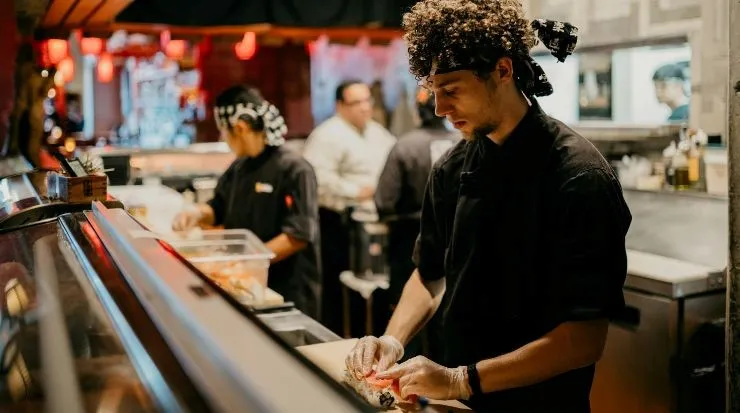
On a Saturday at 7:30pm, there is no time for a training manual.
A new server is asked about an allergen in the special. A bartender forgets the spec for a seasonal cocktail. A supervisor needs to brief the floor team on a menu change before the evening rush. In most venues, the training they need is in a binder, a PDF nobody can find, or in a meeting that happened last Tuesday.
A hospitality staff training app changes that. Not by replacing structure but by putting the right information in the right person’s pocket, at the moment they need it, in a format they will actually use.
What should a hospitality staff training app do?
A hospitality staff training app should deliver short training modules completable in one to two minutes on a mobile phone, generate quizzes automatically from menu content and operational documents, track completion and compliance across every team member and site, and provide instant access to SOPs, allergen information, and operational updates during service. An app that requires a laptop, takes thirty minutes per module, or cannot be updated in real time is not a training app for hospitality. It is a desktop LMS that has been adapted for mobile, and the difference shows in completion rates.
Why the format matters more than the content
A server who needs to check the allergen content of a dish during service has approximately thirty seconds before the guest expects an answer. A training app that opens in two taps, displays the allergen matrix for the current menu, and lets the server answer with confidence is an operational tool. A training platform that requires a login, navigates through multiple menus, and returns a forty-page document is not.
This is the distinction most operators miss when evaluating training technology. They assess content quality and feature lists. They underweight the question of whether the app actually gets used on a busy shift, in the gap between covers, by a team member who is already managing four things at once.
The format that works in hospitality is: one to two minutes, one topic, completable on a phone, accessible offline, and retrievable in seconds during service. Everything else is secondary.
What to look for when evaluating a hospitality staff training app
Mobile-first, not mobile-adapted
The distinction matters. A mobile-first app was designed from the ground up for a phone screen. A mobile-adapted app was built for desktop and then scaled down. The experience on a phone tells you immediately which one you are using. If modules require horizontal scrolling, if text is too small to read without zooming, or if navigation requires multiple taps to reach a specific piece of content, it is adapted, not native.
Ask the vendor to demonstrate the app on an actual phone, not a desktop browser showing a mobile preview. That demonstration will tell you more than any feature list.
AI-generated quizzes from your own content
Building quiz content from scratch takes time that most operators do not have. A manager who needs to create a quiz on the new seasonal menu or an updated allergen matrix should not spend an afternoon writing questions.
PocketTrainer’s AI quiz creation generates quizzes automatically from menu PDFs, product documents, linked files from the platform folder, or copied text. A manager uploads the content and the quiz is generated and ready to assign within minutes. Every team member across every site gets a quiz based on the actual current menu, not a generic food knowledge test.
Leaderboard and gamification
The training apps with the highest completion rates in hospitality are the ones that make completion visible and competitive. A leaderboard that shows weekly and monthly rankings based on quiz scores and course completions creates a dynamic that generic training cannot. Staff who are competing for the top of the leaderboard voluntarily revisit content, retake quizzes, and build knowledge beyond the mandatory minimum.
PocketTrainer’s leaderboard feeds directly from all completed courses and quizzes. Weekly and monthly winners are visible to the whole team. Managers who reference these rankings in briefings or team messages create a culture where training achievement is recognised.
Compliance tracking with certificate management
An app that tracks completion is not the same as an app that tracks compliance. Completion tells you a team member finished a module. Compliance tracking tells you they hold a current certificate, when it expires, and when they are due for a refresher.
For UK operators, this means tracking food safety Level 2 certificates across every team member, with expiry alerts sent automatically before they lapse. For GCC operators, it means maintaining records that satisfy Dubai Municipality or Abu Dhabi Tameen requirements on demand.
PocketTrainer’s Food Safety For Restaurants Level 2 UK, Food Allergen Awareness For Restaurants UK, Basic Food Safety UAE, and HACCP Awareness UAE courses all issue digital certificates automatically on completion, with expiry tracked centrally.
Multi-site rollout in one action
For group operators, the most important operational feature is the ability to push a training update to every site simultaneously. When a menu changes, an allergen is updated, or a new SOP is introduced, every team member across every location should receive the same information at the same time, not in a cascade of manager emails and WhatsApp messages that reaches some sites and not others.
A training app that requires a manager at each site to manually assign new content is not designed for multi-site operations. One that lets head office assign a module to all staff across all sites in a single action is.
If you want to see how PocketTrainer handles multi-site training rollouts, book a 15-minute demo.
An internal news feed alongside the training
The apps with the strongest engagement are the ones staff open for reasons beyond mandatory training. PocketTrainer’s internal news feed sits alongside the training modules, giving managers a channel to share updates, recognise team members, and communicate operational changes. Staff who open the app daily for the news feed see their pending training modules every time. The habit of opening the app converts naturally into training engagement.
The operational benefits beyond education
When training is consistent, trackable, and built into the daily workflow through an app the team actually uses, the operational benefits compound over time:
Menu knowledge is consistent across the team because everyone received the same quiz from the same menu, not a verbal briefing filtered through whoever was paying attention.
Onboarding is faster because compliance modules are completed before day one and role-specific training assigns automatically.
Compliance is documentable because every certificate has a timestamp, an expiry date, and a completion record accessible in seconds.
Service quality improves because staff can reference SOPs, allergen information, and operational procedures on their phone during service rather than finding a manager.
PocketTrainer’s WOW Service, Handling Customer Complaints, The Art Of Selling, Wine Knowledge 101, and Beer Mastery 101 courses cover the service and product knowledge areas that directly affect guest experience and revenue, all in the one to two minute format that gets completed.
FAQs
How long should a microlearning module be in hospitality?
One to two minutes is the optimal range for a hospitality environment. This fits into the natural gaps in a service day: the break between lunch and dinner, the five minutes before a shift starts, the commute in. Modules longer than five minutes see significantly lower completion rates in shift-based environments.
Can a training app reduce staff turnover?
Training is one of the primary drivers of early turnover in hospitality. UKHospitality data shows 42% of staff leave within the first 90 days, most citing poor onboarding and lack of support. A training app that provides structured onboarding, visible career progression, and ongoing development gives new starters a reason to stay and a sense that the employer is invested in them.
Is microlearning suitable for multi-site restaurant groups?
It is particularly well-suited to multi-site groups. The challenge in multi-site operations is consistency: ensuring every site trains to the same standard, with the same content, at the same time. A training app that pushes updates to all sites simultaneously and tracks completion centrally addresses this directly.
What makes a hospitality training app different from a generic LMS?
A hospitality-specific training app is built for the environment: one to two minute modules, mobile-first design, content built around food safety regulations, allergen management, and service standards, and features designed for high-turnover teams with shift-based working patterns. A generic LMS covers the same topics in thirty-minute desktop sessions designed for office workers. The completion rate difference is significant.
Final thoughts
A hospitality staff training app is not a luxury or a technology investment. It is an operational tool that determines whether your team’s knowledge is current, your compliance evidence holds up, and your service standards are consistent from shift to shift and site to site. The right app makes training something that happens continuously in the flow of work, not something that competes with it. Book a 15-minute demo to see how PocketTrainer works for your operation.