
Hospitality LMS Best Practices for Restaurants and Resorts
By Janos Laszlo
- hospitality LMS
- staff training
- best practices
- compliance
- restaurant operations
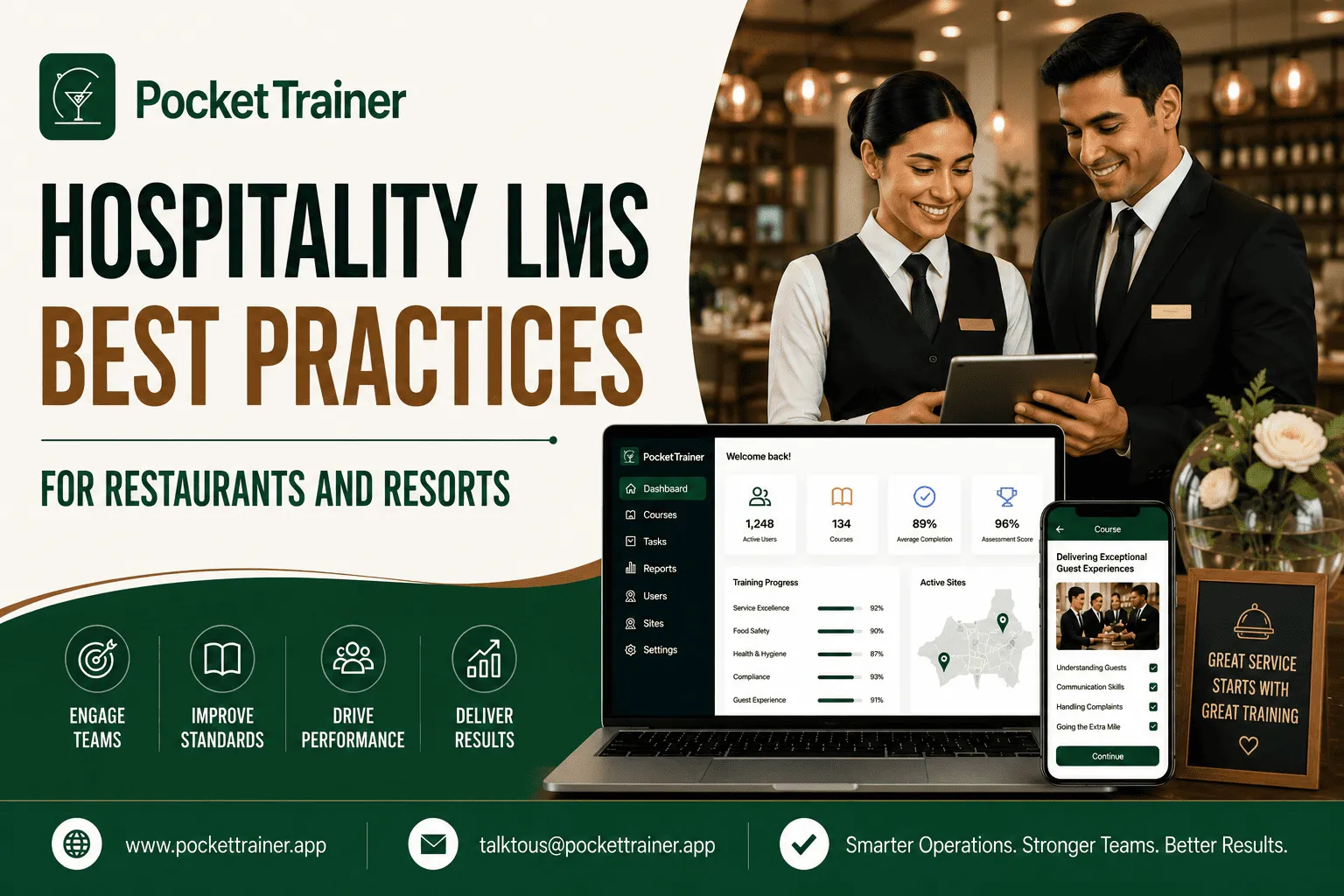
Quick Summary
- Buying a hospitality LMS is the easy part. Getting real adoption, high completion rates, and consistency across sites and departments is where most operators fall short.
- These practices apply equally to restaurants and hotels; the roles differ (housekeeping and front desk instead of servers and kitchen staff), but the mechanics of what makes an LMS actually get used are identical.
- Spaced, short-form training consistently outperforms long-form sessions; research puts the retention gain at 20–30%.
- The operators who see the strongest return treat the LMS as a continuous operational tool, not a twice-a-year event.
Buying a hospitality LMS is the easy part. Getting your team to actually use it, keeping completion rates high, and making the training stick across multiple sites, multiple departments, and high staff turnover is where most operators fall short. This guide covers the practices that separate restaurants and hotels that see a real return from their LMS from those that end up with an expensive system nobody uses.
What are the best practices for a hospitality LMS?
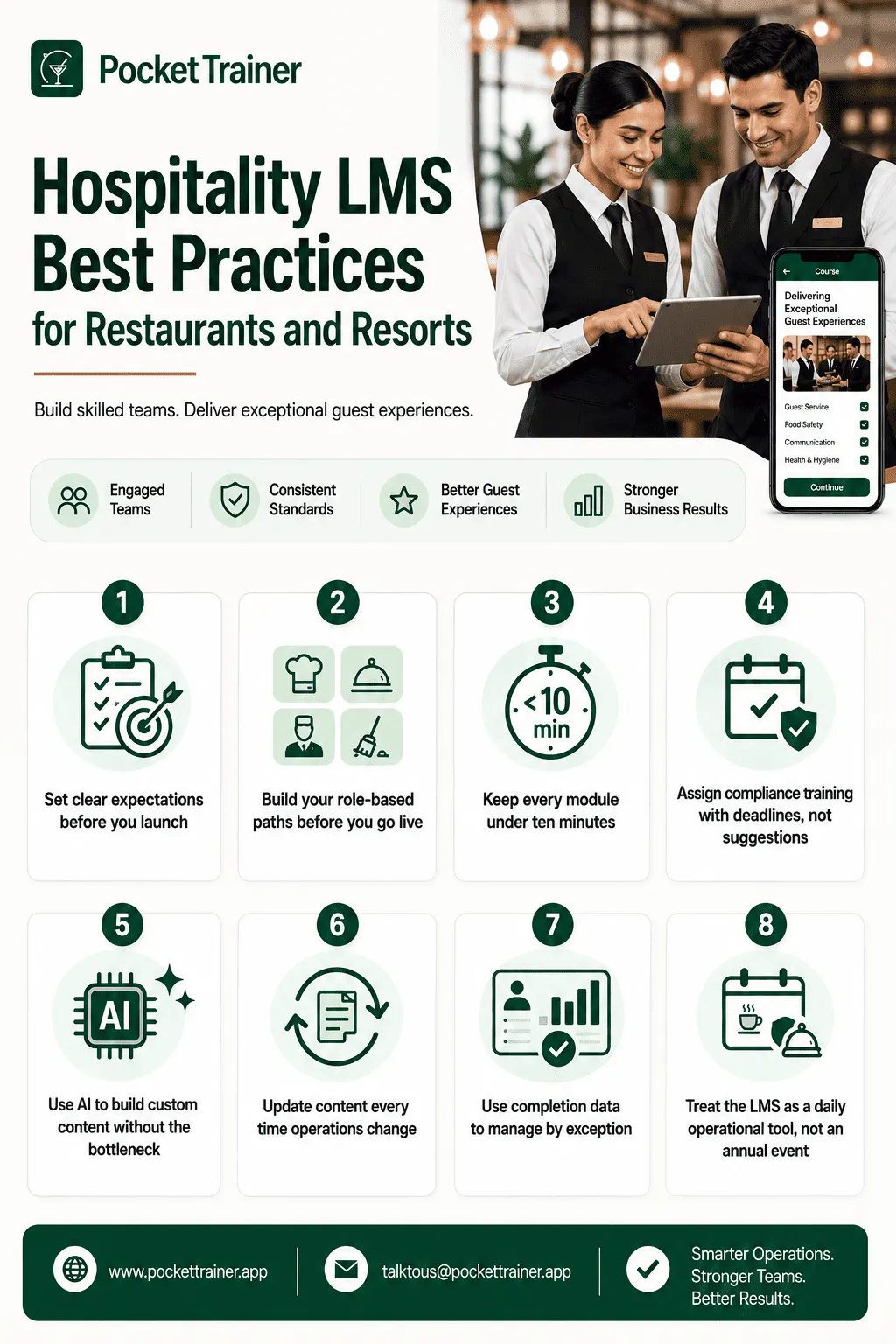
The best practices for a hospitality LMS are: set clear expectations for staff and managers before launch, build role-based onboarding paths for every department, keep modules under ten minutes, assign compliance training with deadlines, not suggestions, update content every time operations change, use completion data to manage by exception, and treat the LMS as a daily operational tool rather than an annual training event. These apply whether you’re onboarding a server, a kitchen porter, a housekeeper, or front desk staff.
1. Set clear expectations before you launch
The single biggest reason hospitality LMS implementations fail is not the technology. It is the absence of clear expectations on both sides of the platform.
For staff, expectations need to be explicit from day one: how many courses are required, what the passing rate is, and what the consequence is for non-completion. A new starter who knows they have five mandatory modules to complete within their probation period, with a minimum passing score of 80%, and that incomplete training will be reviewed at their probation meeting, will treat training differently from one who was told “there’s some stuff to do on the app when you get a chance.”
For managers, accountability needs to be built into their KPIs. A manager whose team completion rate is tracked alongside covers, revenue, and hygiene scores, or occupancy and guest satisfaction in a hotel, will treat training differently from one for whom it is an admin task they get to when the floor is quiet. If training completion is not measured, it will not be managed.
The practical setup: define the mandatory course list for each role, set the completion deadline (typically within the probationary period), set the passing rate, communicate both to the team member on day one, and include completion rate in the manager’s monthly review.
2. Build your role-based paths before you go live
Before you launch, define the training path for each role. In a restaurant: kitchen porter, commis chef, server, bartender, shift leader, manager. In a hotel, the list is broader still: front desk, housekeeping, maintenance, security, spa, and F&B each need their own path, since a housekeeper and a server need almost none of the same content.
For each role, identify the mandatory compliance modules (food safety, allergen awareness, fire safety, COSHH for anyone handling cleaning chemicals), the service and skills modules, and the onboarding content specific to your operation. Build these as pre-set paths that assign automatically when a new team member is added with that role, a mechanic covered in more depth in our guide on onboarding new hospitality staff faster.
This takes a few hours to set up and saves hundreds of hours of management time over the first year. A new starter whose training is automatically assigned, with deadlines set, on the day they are added to the platform requires no manual configuration from the manager.
3. Keep every module under ten minutes
Long modules do not get completed in hospitality. A thirty-minute course that a server or a housekeeper is supposed to complete before their first shift will be deferred, forgotten, and eventually assigned again by a frustrated manager. A ten-minute module that covers one specific topic will be completed on the bus, in the break room, or in the five minutes before the shift starts.
If a topic requires more than ten minutes of training, split it into separate modules. Food safety is not one course. It is temperature control, allergen management, HACCP documentation, cleaning protocols, and personal hygiene, each delivered as a focused, completable unit. Pocket Trainer’s HACCP for managers course is built around exactly this kind of focused documentation training.
Research consistently supports this. Companies using microlearning report roughly 25% higher knowledge retention than long-form training, and spaced practice on its own delivers around 30% higher long-term retention compared to a single long session. In a high-turnover environment, this difference is directly commercial; our guide on microlearning wins in hospitality covers the mechanics in more depth.
4. Assign compliance training with deadlines, not suggestions
A module assigned without a deadline will be completed when the team member gets around to it. In hospitality, that means it will not be completed until a manager chases it, an inspection prompts a scramble, or a certificate expires.
Set hard deadlines for compliance training. Food safety Level 2: completed within the first week of employment. Fire safety: completed before the second shift. Allergen awareness: completed before the first service. These reflect the legal exposure that begins the moment a team member starts work.
Use the platform’s automated reminders to send alerts to the team member when a deadline is approaching and to the manager when it is missed.
Pocket Trainer’s Food Safety For Restaurants Level 2 UK and Food Allergen Awareness For Restaurants UK courses issue certificates automatically on completion and track expiry, so you always know who is current and who is due for a refresher.
If you want to see how compliance tracking works across a multi-site restaurant or hotel operation, book a 15-minute demo.
5. Use AI to build custom content without the bottleneck
A ready-made compliance course library covers the foundation. It does not cover your menu, your brand standards, your specific SOPs, or your service culture. The operators who get the most from their LMS build their own content alongside the ready-made courses.
The barrier has historically been time. Building a custom module from scratch, scripting it, recording it, and uploading it takes hours a manager does not have.
Playing loads the video from YouTube, which may set cookies.
Pocket Trainer’s AI-powered quiz and course creation removes that barrier. A manager can generate a quiz on the new seasonal menu, a course on the updated closing procedure, or a refresher on a specific SOP in minutes, not hours. The AI handles the structure. The manager provides the operational knowledge.
Custom content built this way lives in the same system as the compliance training, assigned and tracked identically. The team does not go to a different place to find it. It appears in their training queue alongside their mandatory modules.
6. Update content every time operations change
A hospitality LMS is only as useful as the currency of its content. A menu change that is not reflected in the training means staff are selling dishes that no longer exist or missing allergen updates. A supplier change that is not reflected in the HACCP documentation creates a compliance gap. In a hotel, the same logic applies to a new housekeeping standard, a refurbished room type, or an updated check-in system.
- Build a simple trigger system: Any operational change that affects how staff does their jobs triggers a content review.
- New menu: Update the menu knowledge module.
- New supplier: Review the delivery and storage SOP.
- New equipment: Add a short module on correct use.
- New regulation: Update the relevant compliance course.
7. Use completion data to manage by exception
Set your threshold: any team member below 80% completion on mandatory training within their first 30 days gets a flag. Any site below 75% compliance on food safety certificates gets a flag. Any module with a completion rate below 60% across the team gets a flag. Review flags weekly. Everything above the threshold runs itself.
This approach works across single sites and multi-site groups, including hotel groups managing several properties. For a group operator with ten locations, whether restaurants or hotels, the dashboard shows which two sites need attention this week. The other eight do not require a meeting, a discipline our guide to standardising training across every location covers in full.
8. Treat the LMS as a daily operational tool, not an annual event
The operators who see the weakest return from their LMS use it for induction and annual compliance refreshers and nothing else. The platform sits idle for months, and the team thinks of training as something that happens twice a year.
The operators who see the strongest return use it continuously: new menu briefings, seasonal training updates, service standard reminders before a busy period, leadership development modules for shift supervisors.
“With Pocket Trainer I’m extremely happy that we are able to communicate at any time, at any day, and everybody gets the same message at the same time.” Judit Toth, then General Manager, INK Hotel Dubai
That’s what a daily operational tool looks like from the hotel side specifically, not a system staff open twice a year, but one woven into how the property actually communicates. This also maintains the habit of completing training. A team member who uses the platform weekly will complete a new mandatory module faster than one who encounters the platform twice a year and has to remember how to log in.
Final thoughts
A hospitality LMS is a tool. Its value depends entirely on how it is used, in a restaurant or a hotel. The practices above require a few hours of setup before launch, a consistent approach to content maintenance, and a shift from treating training as an event to treating it as a continuous operational process. The return is measurable: faster onboarding, stronger compliance, lower turnover, and consistent performance across every shift, every department, and every site.
If you want your alcohol service training delivered and documented across your team, book a 15-minute demo, and we will walk through it with your operation in mind. You can also see the full set of hospitality courses included as standard, and read more about the hospitality LMS that holds the records.
FAQs
1 Are hospitality LMS best practices different for hotels than restaurants?
The mechanics are identical: role-based paths, short modules, hard deadlines, and continuous use, but hotels typically need more distinct role paths, since front desk, housekeeping, maintenance, and F&B each need different content, compared to a restaurant’s narrower set of roles.
2 How short should hospitality training modules actually be?
Under ten minutes is the practical ceiling. Longer topics should be split into focused, single-subject modules rather than one long course, since research shows spaced, short-form training produces 20–30% better knowledge retention than long-form sessions.
3 Why do most hospitality LMS implementations fail?
Most failures come down to the absence of clear expectations, no defined completion deadline, no passing rate, and no manager accountability for team completion, rather than a problem with the software itself.
4 Can AI really replace manually building custom training content?
AI tools can generate the structure of a quiz or course, such as questions built directly from menu content, in minutes rather than hours, but the manager still provides the operational knowledge and reviews the output. It removes the time bottleneck rather than removing human input entirely.
5 How often should hospitality training content be updated?
Content should be updated every time an operational change affects how staff do their jobs, a new menu, a new supplier, new equipment, or a new regulation, rather than on a fixed annual schedule. A simple trigger system tied to operational changes keeps content current without needing a scheduled review process.