
Compliance Training for UK Restaurants and Hotels: The Complete Guide(2026)
By Janos Laszlo
- compliance training
- hospitality compliance
- food safety
- health and safety
- UK law
- restaurant training
Quick Summary
- UK restaurant compliance training splits into two areas: food-specific law (hygiene, HACCP, allergens) and workplace safety law (health and safety, fire, COSHH, manual handling).
- No single statute lists one master course list, but the combined effect of food and safety law means every hospitality business must train staff and evidence it.
- Employment law is now part of the picture too, with the Employment Rights Act 2025 phasing in through 2026 and 2027.
- A training matrix mapping each role to its required courses is what makes multi-site compliance manageable.
- Records matter as much as the training itself: inspectors and the HSE expect dated, attributable proof, not an assurance.
Compliance is the part of running a hospitality business that carries the least glamour and the most risk. Get it right, and nobody notices. Get it wrong, and you face a failed inspection, a poor hygiene rating, an unlimited fine, or, in the worst cases, a prosecution. The average court fine for a health and safety breach in the UK runs to around £150,000, and that is before the reputational damage.
Most of that risk is manageable, and compliance training for restaurants is central to managing it. This is a complete 2026 guide to compliance training for UK restaurants and hotels: the training the law expects, the specific legislation behind each area, and how to deliver and prove it across a team without it becoming a full-time job. It pulls together the individual requirements into one clear picture of restaurant compliance UK operators actually need.
What Does Compliance Training Mean in Hospitality?
Compliance training is the set of courses your staff needs to meet the legal duties that apply to a hospitality business. It splits into two broad groups. The first is food-specific law: food hygiene, HACCP, and allergens, which applies because you serve food. The second is workplace safety law: health and safety, fire, COSHH, manual handling, and more, which applies because you employ people in a hazardous environment.
A useful distinction runs through all of it. Some training is statutory, meaning a specific law requires it. Some is mandatory in practice, meaning the law requires an outcome (safe staff, adequate knowledge) that cannot realistically be met without training, even if no statute names a particular course. Food hygiene is the classic example: the law requires food handlers to be trained, instructed, or supervised, and training is how you meet that. For an operator, the practical answer is the same either way: train your people and keep the records.
What Compliance Training Do UK Restaurants Need?
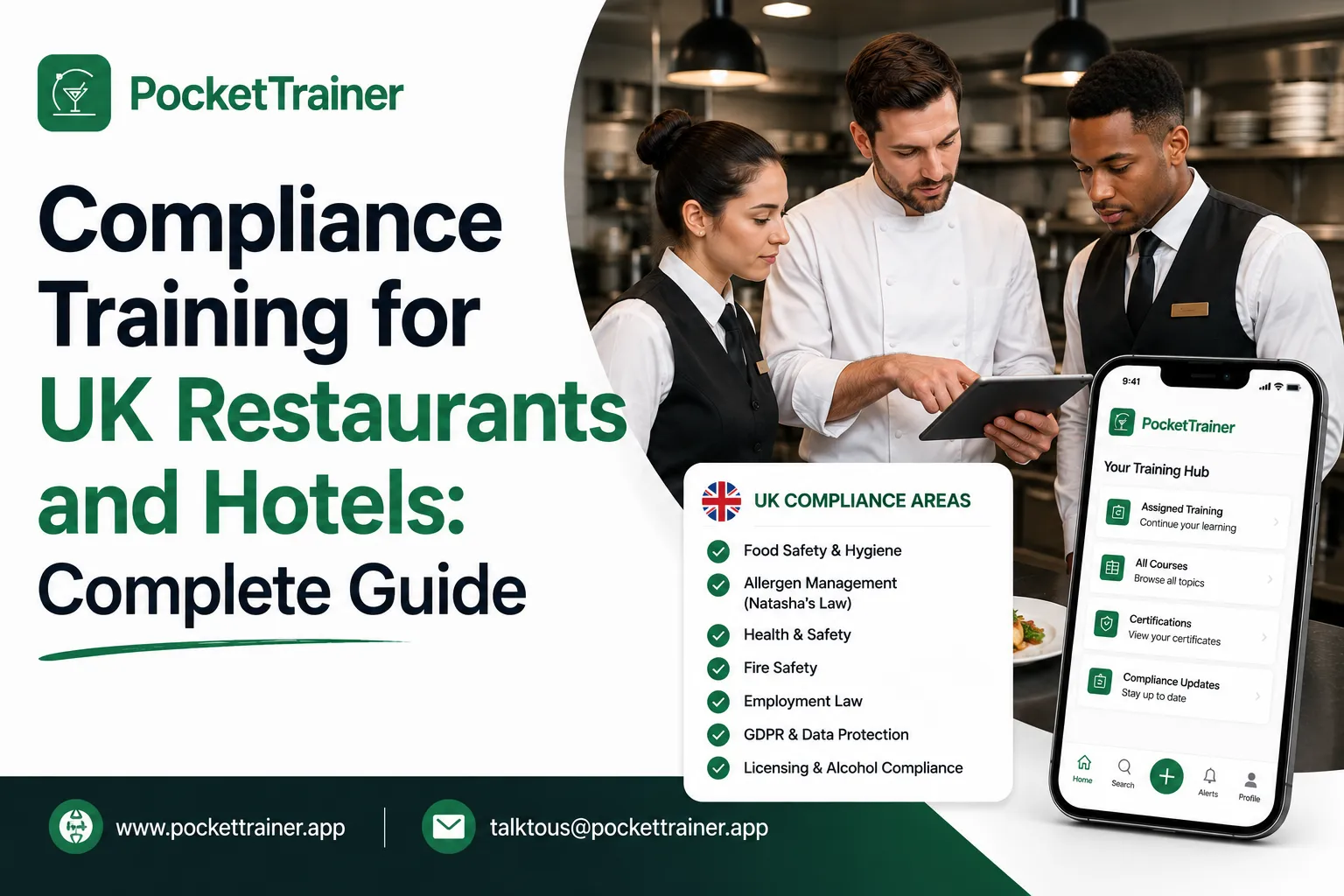
UK restaurants need mandatory training hospitality UK law effectively requires across two areas: food-specific law and workplace safety law. On the food side, this means food hygiene training appropriate to each role, HACCP-based food safety management, and allergen awareness under Natasha’s Law.
On the workplace side, it means health and safety, fire safety, COSHH (chemical safety), and manual handling training, with role-specific additions such as first aid, fire warden, lone worker, or working at height where they apply. No single statute lists one set of mandatory courses, but the combined effect of food and health and safety law is that every hospitality business must train its staff appropriately and be able to evidence it.
Which Food Safety Training Does UK Food Law Require?
This is the training you need because you handle and serve food, and it is where environmental health officers focus, making it central to UK food safety compliance.
Food hygiene comes first. Under retained Regulation (EC) 852/2004 and the Food Safety Act 1990, food handlers must be trained, instructed or supervised in food hygiene to a level appropriate to their role. In practice, this is commonly met through food safety level 2 for those preparing and serving food and level 3 for supervisors and managers. We cover this in detail in our guide on whether food hygiene training is a legal requirement.
HACCP sits alongside it. The law requires every food business to have food safety management procedures based on HACCP principles, and managers responsible for that system need to understand it properly, which our HACCP guide for restaurants explains and the RoSPA-assured HACCP for managers course delivers.
Allergens are the third pillar, and one of the most scrutinised. Under the Food Information Regulations 2014 and Natasha’s Law, businesses must provide accurate allergen information for the 14 major allergens, and staff need allergen awareness training to do it reliably. Our allergen training guide for restaurant staff covers the details and the direction of travel.
What Workplace Safety Training Does Hospitality Law Require?
Your staff are also workers in a high-hazard environment, and a separate body of law requires training on that basis. These apply to hotel compliance training as much as restaurants, since both are covered by the same UK workplace safety framework.
Health and safety is the foundation. The Health and Safety at Work Act 1974 and the Management of Health and Safety at Work Regulations 1999 require employers to provide information, instruction, and training so staff can work safely. Pocket Trainer covers this with health and safety for restaurants and a RoSPA-assured version for managers.
Fire safety is a legal duty for every business. Article 21 of the Regulatory Reform (Fire Safety) Order 2005 requires employers to provide fire training so staff can evacuate and respond safely, covered by fire safety for restaurants, with additional fire warden training for those given that role.
Chemical safety is required under the COSHH Regulations 2002. Kitchens use hazardous cleaning chemicals daily, and staff must be trained to handle, store, and respond to them safely, as covered by COSHH for restaurants.
Manual handling is statutory too. Under the Manual Handling Operations Regulations 1992, training is a legal obligation wherever manual handling cannot be avoided, and around a third of food and drink industry injuries come from manual handling, which makes manual handling training more than a formality.
Then come the role-specific duties: first aid awareness training under the Health and Safety (First-Aid) Regulations 1981, working at height training under the Work at Height Regulations 2005, and lone worker training where staff work unsupervised. A quick note on first aid: awareness training helps staff respond, but where a needs assessment identifies the requirement for designated first-aiders, they must hold a full First Aid at Work or Emergency First Aid at Work qualification from an accredited provider.
Map every role to the right courses and train your team without chasing paperwork, with a live walkthrough built around your operation.
Book a 15-minute demoThe Compliance Area Operators Forget: Employment Law
Restaurant legal training requirements are not only about food and safety. Employment law is tightening fast, and the Employment Rights Act 2025 is being implemented in phases across 2026 and 2027, changing rules on sick pay, zero-hours contracts and harassment. From October 2026, the strengthened duty to prevent sexual harassment and the return of third-party harassment liability make harassment-prevention training a reasonable step employers are expected to take. Our guide to the Employment Rights Act sets out what is changing and when.
How to Actually Manage It: The Training Matrix
Knowing the courses is the easy part. Managing them across a team, with turnover and new starters every month, is where hospitality compliance training succeeds or fails.
The approach that works is a training matrix: map every role to the training it needs, the common compliance core everyone completes, plus the role-specific additions.
| Role | Core compliance training | Role-specific additions |
|---|---|---|
| Kitchen porter / KP | Food hygiene Level 2, H&S, fire safety, COSHH, manual handling | - |
| Waiter/server | Food hygiene Level 2, H&S, fire safety, allergen awareness | - |
| Bar staff | Food hygiene Level 2, H&S, fire safety, allergen awareness | - |
| Duty manager | All of the above, plus HACCP for managers | First aid, fire warden |
| Head chef/kitchen manager | All of the above, plus HACCP for managers, COSHH | Working at height (if applicable) |
A kitchen porter, a waiter, a duty manager, and a head chef do not need identical training, and a matrix like this makes the differences clear. From there, the two things that matter are delivery and evidence. Deliver the training so it actually gets done, and keep records that prove it did.
That second point is where most operators are exposed. The HSE and environmental health officers do not just want training to have happened; they want it evidenced. Incomplete or missing records are a common reason businesses fail inspections or lose a due diligence defence. A stack of paper certificates, some lost, some out of date, is not a system.
How Do You Prove Compliance Training at an Inspection?
You prove compliance training by holding dated, attributable records showing each staff member completed the training their role requires. Inspectors and the HSE expect evidence that training happened, not just an assurance that staff “know what they are doing,” and the Food Safety Act 1990 due diligence defence depends on being able to show reasonable precautions were taken.
A digital platform makes this straightforward by generating a completion certificate for each person, recording their name, venue, the course, and the date completed. Holding these records centrally, across your whole team, is the clearest way to turn a scramble at inspection into a simple report.
Why a Platform Beats a Folder?
This is where a hospitality training platform earns its place. Instead of chasing paper, you assign each role its required courses, deliver them to staff on their phones, and hold every completion record in one place. Nine specific UK compliance courses covering food safety, allergens, COSHH, fire, and health and safety are included as standard on Pocket Trainer and assured by RoSPA Qualifications, so the mandatory floor is covered from day one rather than sourced course by course. Completion generates a dated certificate with the staff member’s name and venue, giving you the evidence trail automatically.
For a multi-site operator, the difference is stark. One dashboard shows who across the business is compliant and who is overdue, instead of a different pile of paper in every venue. Compliance stops being an annual panic and becomes something you can see at a glance.
The Takeaway
Compliance training for a UK restaurant or hotel is not one course but a set, spanning food law (hygiene, HACCP, allergens), workplace safety law (health and safety, fire, COSHH, manual handling, and role-specific training), and now employment law under the Employment Rights Act 2025. No single statute lists them all, but together they mean every hospitality business must train its staff appropriately and prove it. The operators who pass cleanly are the ones who map training to roles, deliver it reliably, and hold a dated record for every completion.
Deliver and document compliance training across your whole team, with core courses included and everything mapped to your operation.
Book a 15-minute demoYou can also see the full set of hospitality courses included as standard and read more about the hospitality LMS that holds the records.
FAQs
1. Is compliance training a legal requirement for UK restaurants?
Yes, in effect. No single law lists one named “compliance training course,” but food safety law requires trained, instructed, or supervised staff, and the Health and Safety at Work Act 1974 requires employers to provide training so staff can work safely. Together, these make structured compliance training a practical legal necessity for every restaurant and hotel.
2. What is the difference between statutory and mandatory training?
Statutory training is required by a specific named law, such as fire safety training under the Regulatory Reform (Fire Safety) Order 2005. Mandatory-in-practice training is required because the law demands an outcome, such as safe food handling, that cannot realistically be achieved without it, even though no statute names a specific course.
3. How often does compliance training need to be refreshed?
Refresh intervals vary by course and are typically set by the training provider rather than a single law; food hygiene and health and safety courses are commonly renewed every three years, with role changes or incidents triggering earlier refreshers. Checking each course’s stated validity period is the safest approach.
4. Does compliance training apply differently to hotels than restaurants?
The core workplace safety law (health and safety, fire, COSHH, manual handling) applies equally to hotels and restaurants, since both are workplaces with staff and hazards. Food-specific training (hygiene, HACCP, allergens) applies wherever a hotel serves food, which most do, so hotel compliance training typically covers the same ground as restaurant compliance training.
5. What happens if a restaurant cannot prove staff completed compliance training?
Without dated, attributable records, a business loses its strongest defence at inspection or in the event of an incident: the ability to show reasonable precautions were taken under the Food Safety Act 1990 due diligence defence. Missing records are a common reason businesses fail inspections, regardless of whether training actually took place.