
Food and beverage training solutions for Restaurants & Bars
By Janos Laszlo
- food and beverage training solutions
- restaurant staff training
- bar staff training
- hospitality training software
Quick Summary
- Restaurants and bars need consistent, accessible staff training.
- Digital training makes procedures, product knowledge, and compliance information easier to access.
- Hospitality teams benefit from mobile learning and structured training content.
- Digital training can help businesses maintain consistency across roles and locations.
- The right platform should support both day-to-day service and ongoing compliance training.
Walk into a well-run restaurant or bar, and the difference is usually visible quickly. Service flows, staff know their roles, customers receive consistent information, and the team can respond confidently when something changes.
That consistency does not happen by accident. It comes from clear procedures, practical training, and resources that staff can access when they need them.
For restaurants and bars, traditional binders and verbal instructions can become difficult to maintain as teams change, menus evolve, and new staff join. Modern food and beverage training solutions give hospitality businesses a way to organise training, service standards and operational knowledge in one accessible system.
The Changing Training Needs of Restaurants and Bars
Restaurants and bars operate in an environment where teams, menus and service requirements can change regularly.
New starters may have limited hospitality experience, while managers often have limited time to deliver repeated training during busy shifts.
Without a clear training system, this can lead to:
- Different service procedures across shifts
- Inconsistent onboarding for new staff
- Training materials that are difficult to find
- Outdated menu or operational information
- Limited visibility of staff training progress
Food and beverage training solutions can help bring these elements into a more structured system, giving staff a consistent place to learn and managers a clearer view of training activity.
What are the Common Training Gaps in Hospitality Teams
Many restaurants and bars struggle with the same basic training problems.
Inconsistent Onboarding
New starters may receive different information depending on who is training them and how busy the shift is.
Difficult-to-Find Training Materials
Printed manuals, spreadsheets, and scattered documents can make it harder for staff to find the information they need.
Outdated Operational Information
Menus, recipes, service procedures, and product information can change, but old training material may remain in circulation.
Limited Training Visibility
Managers need to know who has completed required training and where further training is needed.
A structured digital system can help address these gaps while keeping training accessible to frontline teams.
What should a food and beverage training solution include?
Food and beverage training solutions are systems, programmes and resources designed to help restaurant and bar teams develop the knowledge and skills required for their roles.
They can combine:
- Food and beverage service training
- Product and menu knowledge
- Service procedures
- Compliance training
- Quizzes and knowledge checks
- Training records
- Ongoing operational updates
Instead of relying only on memory, shadowing, or verbal instructions, teams have a consistent source of training information.
For a restaurant or bar, that can make it easier to keep procedures consistent and give staff access to the information they need during their working day.
A Digital Upgrade Through Restaurant Training Manuals and Handbooks
Restaurant training manuals and handbooks remain useful for documenting procedures, policies, and service standards.
The challenge is keeping them accessible and current.
A printed manual can be difficult to update and easy to leave behind in a back office. A digital version can make the same information available to staff from their phones and easier for managers to update when procedures change.
Benefits of Digital Training Manuals
Digital restaurant training manuals can help staff:
- Review procedures when needed
- Learn at their own pace
- Access information from a phone
- Keep up with menu and service changes
- Refer back to important standards
For managers, digital content can also reduce reliance on repeatedly explaining the same procedures to every new starter.
Traditional Manuals vs Digital Manuals
| Feature | Traditional Manuals | Digital Manuals |
|---|---|---|
| Access | Limited to where the manual is stored | Accessible from supported devices |
| Updates | Manual | Easier to update centrally |
| Engagement | Mainly reference-based | Can include interactive learning |
| Scalability | Harder across multiple sites | Easier to distribute across locations |
Bar Training Manual Essentials for Consistent Service
Speed and precision matter behind the bar.
A bar training manual should give staff clear information about the drinks and service standards they are expected to follow.
Depending on the operation, this can include:
- Drink recipes and measurements
- Hygiene and cleaning procedures
- Responsible alcohol service
- Customer interaction standards
- Product and ingredient knowledge
Clear guidance can help new bartenders learn more consistently and give experienced team members a reliable reference when something changes.
A digital bar training manual can make this information easier to access and update without relying on a physical handbook.
Compliance Training for Restaurants
Compliance training is an important part of restaurant operations, but it should be treated as part of the wider food safety and workplace safety system rather than as a standalone solution.
UK food businesses must ensure staff have the appropriate skills and up-to-date training for their roles and keep records of completed training. Staff must also be trained to manage food allergies.
The specific training required depends on the employee’s role and responsibilities.
For restaurant teams, relevant areas may include:
- Food safety and hygiene
- Allergen management
- Health and safety
- Fire safety
- COSHH where relevant to the role
- Responsible alcohol service where applicable
The Food Standards Agency’s allergen guidance also highlights the need for staff to understand how to handle allergen information requests and prevent allergen cross-contamination.
How does staff training help restaurants maintain compliance?
A structured training system can help by:
- Standardising important procedures
- Reinforcing food safety practices
- Giving staff access to current information
- Recording completed training
- Helping managers identify training gaps
Training does not replace the restaurant’s food safety management procedures or other operational controls. It supports the people who need to follow them.
What Training Should Restaurant and Bar Staff Complete?
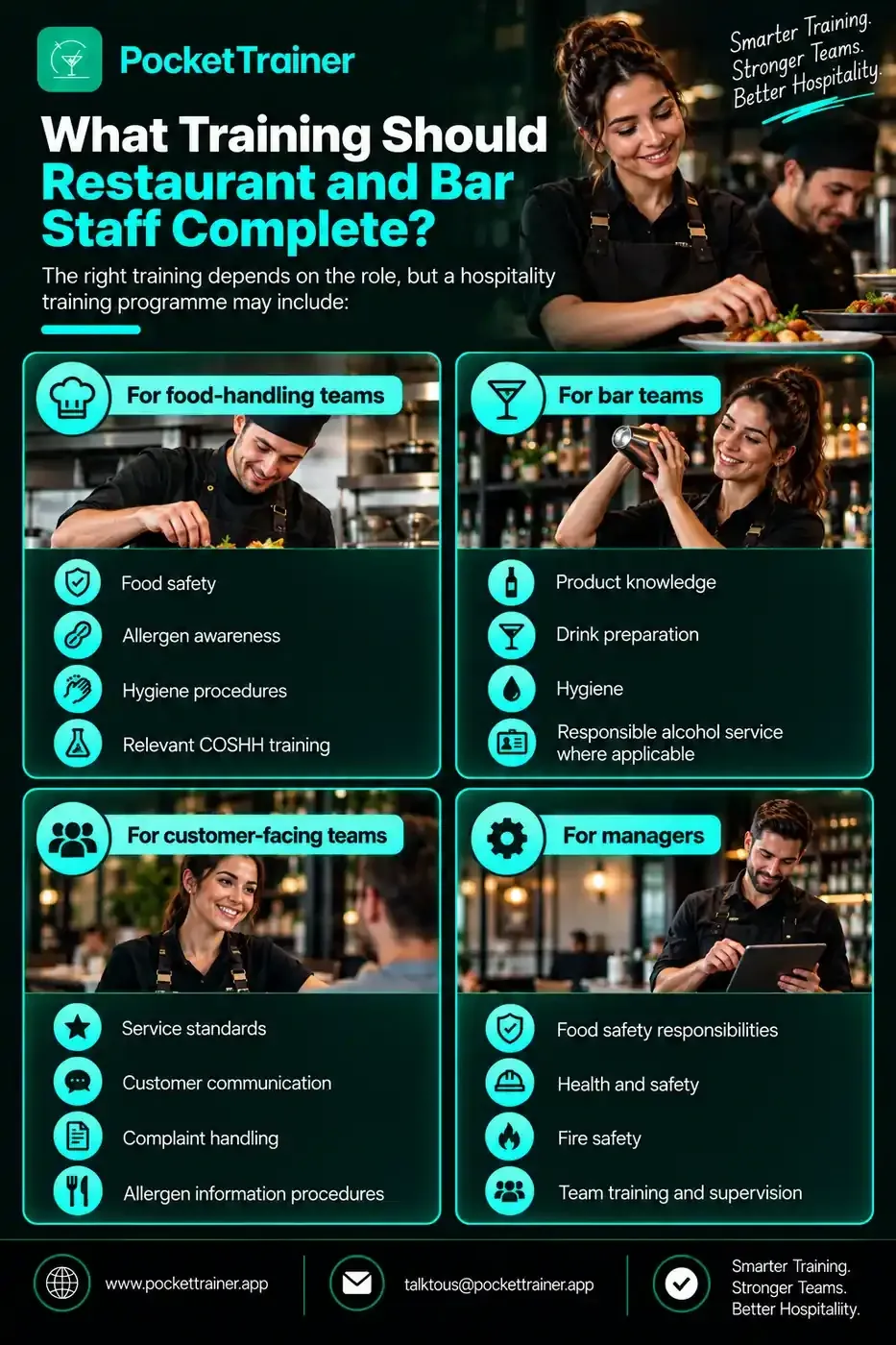
The right training depends on the role, but a hospitality training programme may include:
For food-handling teams
- Food safety
- Allergen awareness
- Hygiene procedures
- Relevant COSHH training
For bar teams
- Product knowledge
- Drink preparation
- Hygiene
- Responsible alcohol service where applicable
For customer-facing teams
- Service standards
- Customer communication
- Complaint handling
- Allergen information procedures
For managers
- Food safety responsibilities
- Health and safety
- Fire safety
- Team training and supervision
How Pocket Trainer Supports Smarter Training
Pocket Trainer brings hospitality training content, operational knowledge, and training records into a mobile-friendly platform.
Restaurants and bars can use it to organise:
- Food and beverage staff training
- Service procedures
- Product and menu knowledge
- Compliance training
- Quizzes and knowledge checks
- Training records
The hospitality LMS gives teams a central place to access training and operational information.
Businesses can also use custom training content to turn their own procedures, menus and standards into structured training.
For ready-made hospitality training, the hospitality course library includes areas such as food safety, HACCP, health and safety, and fire safety.
Bring your own compliance requirements and ask to see the completion record produced live, filtered by site and role.
Book a 15-minute demoChoosing the Right Food and Beverage Training Programme
A common question is:
What are the best online food and beverage training programmes for entry-level staff?
There is no single programme that is right for every restaurant or bar. Look for training that is:
- Relevant to the employee’s role
- Easy to access
- Suitable for the learner’s level
- Based on realistic hospitality scenarios
- Easy for managers to track
- Simple to update when procedures change
Another common question is:
How do you enrol staff in food and beverage training?
Digital platforms can simplify enrolment by allowing managers to assign training through a central dashboard rather than relying entirely on paper forms or manual tracking.
A third question is:
How long is a typical food and beverage course?
Course length varies significantly depending on the subject, learner level, and training format. Short modules can work well for specific operational knowledge, while formal food safety or management training may require more substantial learning.
The important factor is not simply course length. It is whether the training is appropriate for the role and provides the knowledge the employee needs.
Building a Scalable Training System for Growth
Training requirements often become more complicated as restaurants and bars grow.
Opening additional locations, hiring new teams, and maintaining the same service standards across multiple venues all require a repeatable approach to training.
Scalable food and beverage training solutions can help businesses:
- Train multiple teams consistently
- Update content centrally
- Support new starters
- Maintain brand standards across locations
- Track training completion
For multi-site hospitality groups, this can make it easier to keep operational knowledge aligned while allowing individual teams to access the training relevant to their roles.
What Should You Look for in a Food and Beverage Training Solution?
Before choosing a platform, test it against the way your restaurant or bar actually operates.
Ask:
- Can staff access training easily from their phones?
- Can we add our own menus, recipes, and service standards?
- Can managers assign training by role or location?
- Can we track completion and training records?
- Can content be updated when procedures or menus change?
- Does it include relevant hospitality and compliance training?
A platform that looks impressive in a generic software demo still needs to work with your actual team, content, and operating environment.
Train Smarter, Serve Better
Great service depends on more than individual talent.
Clear procedures, relevant training and accessible operational information help teams understand what is expected of them and give managers a more consistent way to support learning.
Modern food and beverage training solutions can bring restaurant and bar training into a structured digital environment, while hospitality-specific content can keep learning connected to the real work teams do every day.
For businesses with their own menus, recipes, procedures, and brand standards, the ability to maintain that content is just as important as the course library.
Final Thoughts
Restaurants and bars need training that works at the speed of hospitality.
Digital food and beverage training solutions can make procedures, product knowledge, and compliance learning easier to access while giving managers better visibility of training activity.
The right approach is not simply to move a paper manual onto a screen. It is to create a training system that staff can actually use, managers can maintain, and the business can scale across roles and locations.
Bring your own compliance requirement and ask to see the completion record produced live, filtered by site and role.
Book a 15-minute demoFAQs
What are food and beverage training solutions?
Food and beverage training solutions are programmes, resources or digital platforms designed to help restaurant and bar teams learn the knowledge and skills required for their roles. They can include service training, product knowledge, compliance training, quizzes and training records.
What should be included in restaurant staff training?
Training should reflect each employee’s role and responsibilities. Depending on the operation, this can include food safety, allergen management, service standards, customer service, health and safety, fire safety and role-specific procedures.
Are digital restaurant training manuals better than printed manuals?
Digital manuals can make information easier to access and update, particularly across multiple locations. However, the important consideration is whether the format helps staff find and use the information they actually need.
How often should restaurant training be updated?
There is no single update schedule for every type of training. Training should be reviewed when legislation, procedures, menus, ingredients, equipment, or other relevant working practices change. Staff also need training that remains appropriate and up to date for their roles.
Can Pocket Trainer support both compliance and operational training?
Yes. Pocket Trainer provides hospitality-focused courses alongside tools for businesses to create and manage their own training content, including menus, procedures and service standards.