
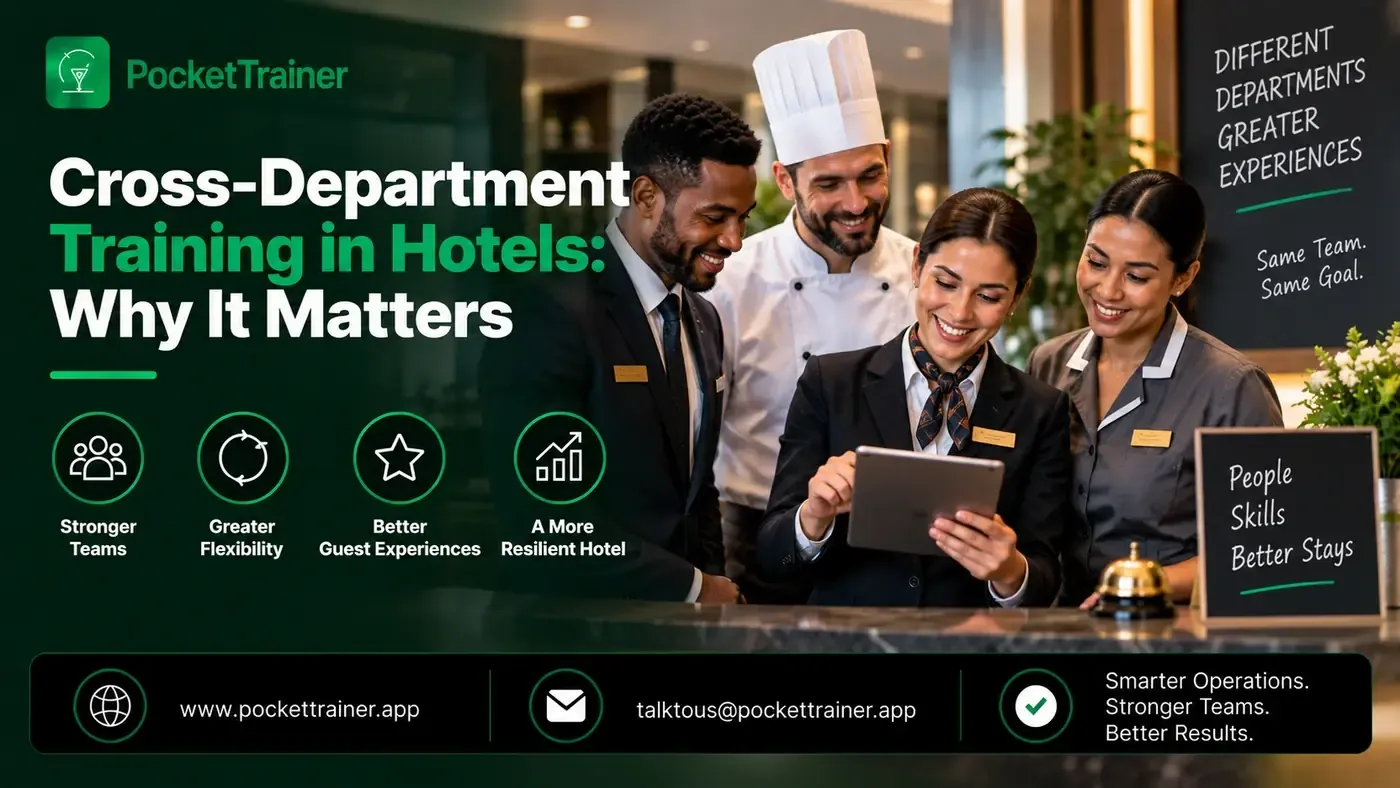
Cross-Department Training in Hotels: Why It Matters
By Janos Laszlo
- cross-department training
- hotel training
- staff development
- hospitality LMS
- guest satisfaction
Quick Summary
- Cross-department training helps hotel employees understand how neighbouring teams work, communicate more effectively, and support defined operational tasks when demand changes.
- Cross-training does not mean everyone performs every role. A strong programme combines department awareness, targeted training, practical supervision and clear competence checks.
- UK compliance still applies. Employees taking on different duties need appropriate training and supervision for the work they actually perform, including relevant food safety, allergen, health and fire-safety requirements.
- Hotels have a significant skills-development challenge. The UK Government Employer Skills Survey 2024 found that 6.2% of employees in the Hotels and Restaurants sector were judged by employers to have a skills gap, the highest skills-gap density of any sector surveyed.
Why cross-department training matters in hotels
A hotel guest’s experience does not belong to one department.
It begins when a reservation is made, continues through check-in, housekeeping, food and beverage, concierge and other guest services, and ends at checkout. Every handoff between teams is an opportunity to keep the experience consistent or introduce unnecessary friction.
That makes cross-department training in hotels more than a staff-development exercise. Done properly, it gives employees a clearer understanding of the teams they work with, the information those teams need, and the boundaries around what they can and cannot do.
The latest Employer Skills Survey found that Hotels and Restaurants had a 6.2% skills-gap density in 2024, meaning employers judged that proportion of employees to lack full proficiency. The sector also had the highest proportion of employers reporting at least one skills gap, at 15%. UK Government Employer Skills Survey 2024
Cross-department training cannot solve every staffing or skills challenge. It can, however, give hotel teams a more connected understanding of how the operation works.
What is cross-department training in hotels?
Cross-department training is a structured approach to giving employees relevant knowledge or skills outside their primary department.
For example:
- A front desk employee learns how housekeeping communicates room status and how to escalate a room-readiness issue.
- A housekeeping employee understands how front office priorities affect room turnaround and guest communication.
- An F&B employee understands how guest requests are communicated from reception to the restaurant.
- A concierge team member understands which requests can be handled directly and which need to be passed to another department.
- A supervisor learns the responsibilities and escalation routes of departments they may need to coordinate during busy periods.
The objective is operational understanding, not universal role replacement.
That distinction is important. Knowing how another department works does not automatically make someone competent or authorised to perform that department’s specialist duties.
1. It improves communication between departments
Hotel operations depend on handoffs.
A guest may report a maintenance issue to reception. Housekeeping may identify a room problem during servicing. A dietary requirement may be communicated before a restaurant booking. A late check-out may affect housekeeping planning.
If the receiving team does not understand the information it needs, communication can break down.
Cross-department training helps employees understand:
- who owns a task
- what information another team needs
- where information should be recorded
- which issues require escalation
- which requests they can handle themselves
- when responsibility needs to return to the specialist department
This is particularly valuable during busy periods when employees have less time to explain processes from scratch.
2. It strengthens operational resilience
Hotel demand can change quickly.
Large group arrivals, peak check-in periods, seasonal demand, staff absence and unexpected operational issues can put several departments under pressure at the same time.
Cross-training can give a hotel a wider pool of employees who understand adjacent workflows.
For example, a front-office employee with housekeeping awareness may understand why a room cannot be promised simply because it appears vacant. An F&B employee who understands basic front-office procedures may be able to answer an appropriate guest query or direct it correctly rather than sending the guest from one department to another.
But there is an important boundary:
Cross-training should never mean asking an employee to perform unfamiliar or higher-risk work without the appropriate training, supervision and competence.
The HSE training guidance should be considered when employees take on different work or additional responsibilities.
3. It can create a more consistent guest journey
Guests do not normally think about a hotel’s organisational structure.
They expect the property to communicate internally and avoid making them repeat the same information unnecessarily.
Cross-department training can support this by giving employees a shared understanding of:
- guest requests
- escalation procedures
- room-status communication
- service recovery
- accessibility-related requirements
- restaurant and booking processes
- maintenance reporting
- special occasions
- departmental responsibilities
The objective is not for everyone to solve every problem. It is for employees to know what they can do, what they should communicate, and who should take over.
That distinction makes cross-training safer and more practical.
4. It helps employees understand the wider hotel operation
Department-specific training can sometimes make an employee’s role feel isolated.
Cross-department learning gives employees a clearer picture of how their work affects colleagues and guests.
A housekeeping employee can understand why accurate room-status information matters to reception. A receptionist can understand the operational implications of room turnaround times. An F&B employee can understand how guest information needs to move between front office and the restaurant.
This creates better operational awareness without requiring every employee to become a specialist in every function.
5. It can support internal development
Cross-department training can also become part of a structured development programme.
An employee interested in moving from housekeeping to front office, for example, may begin with awareness training before progressing to role-specific learning, supervised experience and a formal competence assessment.
The same approach can work across other departments.
However, cross-training should not be presented as an automatic route to promotion. A better approach is to connect training with clearly defined development expectations.
Managers can use performance conversations to discuss:
- current competencies
- skills the employee wants to develop
- possible future roles
- training requirements
- practical experience
- competence milestones
This makes career development more transparent without promising an outcome that has not been agreed.
How to structure cross-department training in practice
A practical hotel programme can use three levels.
Tier 1: Department awareness
Give employees a short introduction to the departments they work with most often.
The training can explain:
- what the department does
- its main priorities
- what information it needs
- common handoffs
- escalation routes
- relevant service standards
- important boundaries
This is awareness training, not authorisation to perform another department’s role.
Tier 2: Foundation skills
Selected employees receive more detailed training in an adjacent department.
Examples might include:
- front office and housekeeping
- front office and F&B
- concierge and guest services
- housekeeping and maintenance coordination
- F&B and guest services
The content should be based on a genuine operational requirement rather than training people in tasks they are unlikely to use.
Tier 3: Defined role coverage
A smaller group may need enough training to provide defined cover for another function.
At this stage, the hotel should establish:
- which duties the employee may perform
- required training
- required supervision
- competence checks
- system permissions
- escalation responsibilities
- tasks that remain restricted to specialist employees
This is where a training matrix becomes particularly useful.
Cross-department training and UK compliance
Cross-training is not itself a general legal requirement for UK hotels.
However, employees must have appropriate training, information and supervision for the work they actually perform.
For food handling, UK Government food-business staff training guidance says staff must have the right skills and up-to-date training for their role. Food handlers do not universally need a food hygiene certificate, but staff must be trained to manage allergies.
For allergens, hotels handling food must provide accurate allergen information, prevent allergen cross-contamination and provide appropriate allergen training. FSA allergen guidance is the appropriate source for these requirements.
For fire safety, hotel staff need appropriate information, instruction and training based on the hotel’s fire risk assessment, emergency procedures and staff responsibilities. The official GOV.UK fire-safety guidance for sleeping accommodation specifically covers hotels and requires appropriate fire-safety training.
These requirements should be treated separately from general cross-department awareness training.
What should hotel cross-department training cover?
The exact programme should depend on the hotel’s operation, but these are common areas where cross-training can be useful.
Front office and housekeeping
Cover:
- room-status terminology
- room-readiness communication
- maintenance escalation
- early check-in and late check-out processes
- guest-request handoffs
- accessibility-related communication
- privacy considerations
Front office and F&B
Cover:
- restaurant operating information
- booking processes
- communicating guest requests
- dietary and allergen information
- room-service processes
- complaint escalation
- relevant billing or posting procedures
Employees should know where reliable allergen information comes from and who is responsible for confirming it. They should never guess about allergens.
Housekeeping and maintenance
Cover:
- defect reporting
- urgent versus routine issues
- room out-of-order procedures
- communication during inspections
- escalation routes
- boundaries around technical work
Awareness training should never be treated as permission to carry out specialist maintenance work.
Concierge and guest services
Cover:
- guest request handling
- escalation
- internal communication
- service recovery
- accessibility awareness
- managing expectations
The objective is to reduce unnecessary handoffs while ensuring requests reach the right person.
Use training records to show what employees can actually do
Completion alone does not tell a manager whether an employee is competent to perform a task.
A stronger training record can show:
- employee name
- department
- training topic
- date completed
- knowledge assessment
- practical assessment where relevant
- supervisor sign-off
- permitted duties
- refresher or review requirement
This becomes particularly useful when training is spread across multiple properties or departments.
For food businesses, GOV.UK specifically advises keeping records of staff training so evidence can be shown during an inspection.
Keep the training practical
Cross-department training does not need to mean long classroom sessions.
A hotel can combine:
- short digital modules
- SOPs
- department briefings
- shadowing
- demonstrations
- supervised practice
- knowledge checks
- manager observation
- documented competence checks
The learning method should match the objective.
Awareness may work well through a short digital module. A practical skill may require demonstration and supervised practice.
Where PocketTrainer can fit
A hospitality training platform can help hotels assign different learning paths according to department, role, and development requirements.
For example, PocketTrainer’s hospitality training platform can be used to structure and track training across hotel teams, while individual learning requirements can be aligned with the employee’s department and responsibilities.
The important point is to build the training around the hotel’s operating model first, then use the platform to deliver and track it.
Bring your own compliance requirement and ask to see the completion record produced live, filtered by site and role.
Book a 15-minute demoFinal thoughts
Cross-department training is not about making everyone capable of doing every job.
It is about giving hotel employees enough understanding of the wider operation to communicate effectively, support colleagues within defined boundaries, and understand how their work affects the guest journey.
The strongest programmes combine department awareness with targeted foundation training, supervised practical development and clear competence records.
That approach gives hotel managers a more connected workforce while keeping role-specific training, safety and compliance requirements intact.
Bring your own compliance requirement and ask to see the completion record produced live, filtered by site and role.
Book a 15-minute demoFAQs
What is cross-department training in a hotel?
It is a structured approach to giving employees relevant knowledge or skills from another department so they can communicate better, understand operational dependencies and, where appropriately trained, provide defined support.
Is cross-department training legally required in UK hotels?
No. There is no general UK legal requirement to cross-train hotel employees across departments. However, employers must provide appropriate training, information and supervision for the work employees actually perform.
Can a cross-trained employee cover another hotel department?
Potentially, but only for clearly defined duties for which they have received appropriate training and, where necessary, demonstrated competence. Cross-department awareness alone should not be treated as authorisation to perform specialist or higher-risk work.
Does cross-training replace food safety training?
No. If an employee handles food, they need appropriate food hygiene and safety training, including allergen training. General F&B awareness does not replace role-specific food safety training.
How should hotels measure cross-training?
Track practical outcomes such as handoff errors, escalation delays, staffing-gap coverage, internal progression, competence assessments and relevant guest-service issues. Course completion alone should not be treated as proof that cross-training has improved the operation.