
How Bulldozer Group Used Training to Standardise Brands and Attract Talent
By Janos Laszlo
- Bulldozer Group
- multi-brand training
- hospitality training platform
- staff retention
- hospitality HR
- staff training
Quick Summary
- For a multi-brand hospitality group, training is a balancing act: every brand needs its own identity, but the group still needs consistency and compliance across all of them.
- Bulldozer Group operates 20+ distinct F&B and lifestyle brands across the Middle East and Europe from its Dubai DIFC base.
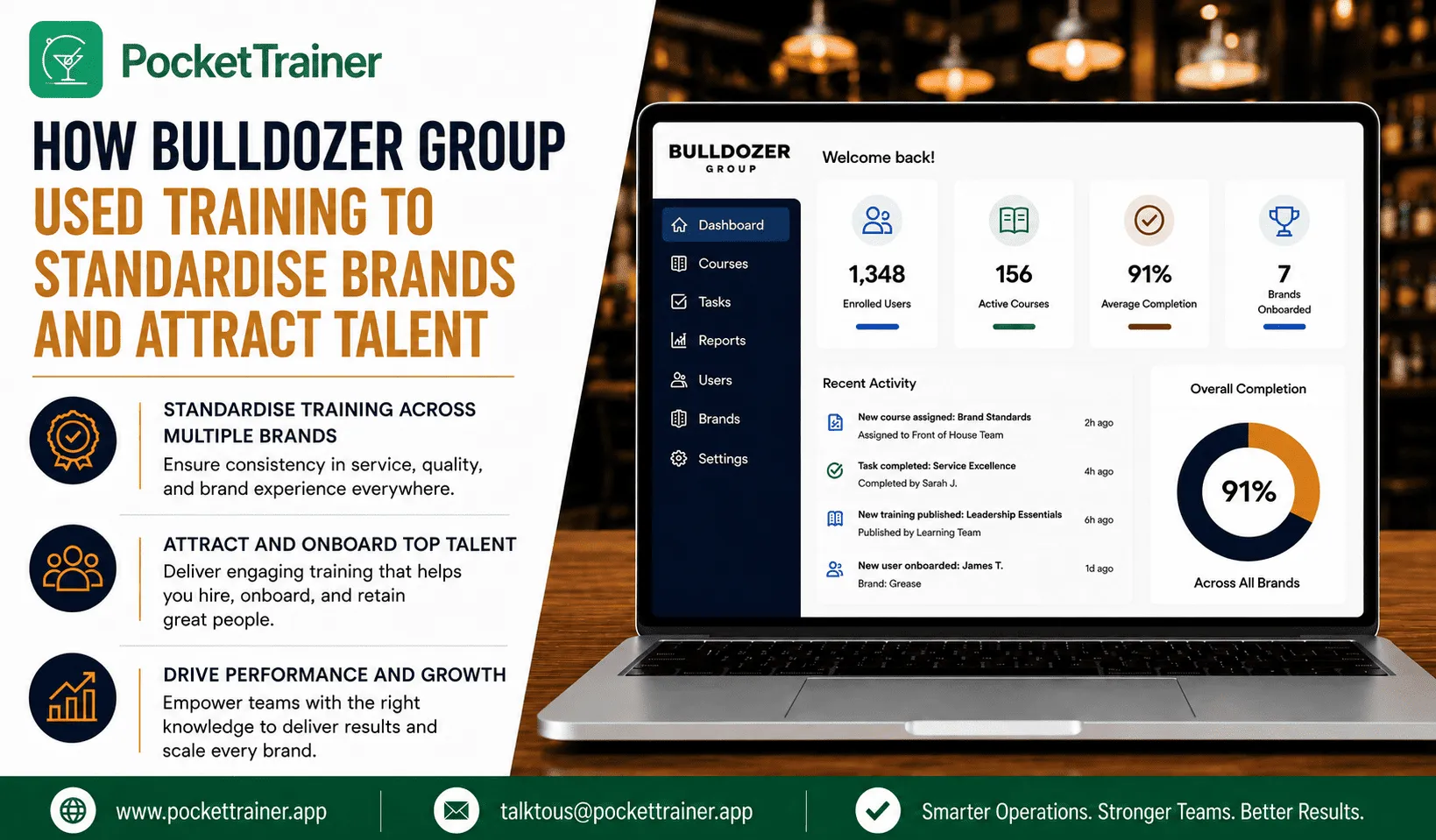
- Its HR director described a hospitality training platform as the tool that let brand-specific standards coexist with central, cloud-based visibility.
- Training turned out to be a recruitment and retention lever too, staff and candidates alike cited visible growth paths as a reason to join and stay.
- Floor teams and leadership independently described the same outcome: happier, better-informed staff and a smoother onboarding experience for a younger workforce.
For a multi-brand hospitality group, training is a balancing act. Every brand has its own identity, standards and way of doing things, so a one-size-fits-all approach does not work. Yet the group still needs oversight, consistency and compliance across all of them, often across several countries. Bulldozer Group operates at exactly this intersection, and its HR director and floor teams described how a hospitality training platform helped them hold it.
This is a look at multi-brand hospitality training from the people who ran it, from the group HR director managing standards across countries to the supervisors and floor staff using the platform every shift. Their words point to two things a modern group needs training to do: customise across brands, and help attract and keep talent.
How Do Multi-Brand Hospitality Groups Manage Training?
Bulldozer Group, founded in 2011 and based in Dubai’s DIFC, is a leading investment and brand management company that develops, owns and operates F&B, hospitality and entertainment concepts across the Middle East and Europe, with a portfolio of more than 20 restaurants and lifestyle venues. Its concepts span distinct, high-profile brands, each with its own character, which is precisely what makes group-wide multi-brand training difficult.
The core tension is that a multi-brand group cannot train every venue the same way, but it cannot let every venue go its own way either.
“I see Pocket Trainer as really a very helpful tool for us because we are multi-brand, first and foremost. Multi-brands, you have the tendency to have your own brand standards, and you have to customise it as per the venue. And it’s not like the traditional, one-size-fits-all, unfortunately, and this is why it’s helping us a lot. And the ability obviously to reach out to all the audience in different countries, so it’s readily available, 24/7, it’s cloud based, and it’s really helpful for us, especially for myself because I would not be able to travel a lot in one week, but I’ll be able to see the progress of training through the system.” Melanie Ortiz, Group HR Director, Bulldozer Group
That single quote captures the whole multi-brand problem and its solution: brand-specific customisation, reach across countries, and central visibility without the HR director having to be physically present, exactly the kind of visibility hospitality HR teams are increasingly expected to deliver.
How Does A Multi-Brand Hospitality Group Keep Training Consistent?
A multi-brand hospitality group keeps training consistent by using a hospitality training platform that lets each brand customise its own standards while giving head office central visibility across every venue and country. A one-size-fits-all approach does not work, because each brand has its own identity and standards, so the platform must support brand-specific content.
At the same time, group leaders such as an HR director need to see multi-brand training progress across all brands without travelling to each site, which cloud-based, always-available reporting provides. This combination of local customisation and central oversight is what allows a multi-brand group to hold quality and compliance across a diverse portfolio.
Want to see how a hospitality training platform can adapt to your brands, not the other way around?
Book a 15-minute demoCan Training Help Attract Hospitality Talent?
The sharpest insight from Bulldozer was that training is not only an operational tool; it is also a recruitment and retention one. In a competitive market, what a company offers its people shapes who it can hire.
“Whenever I’m speaking to potential employees, this is one of the things they are asking. They want to grow within the company. If we have a system in place for training, I think it’s easier for us to sell and attract the unique and talented markets out there.” Melanie Ortiz, Group HR Director, Bulldozer Group
Training became part of the pitch to candidates, evidence that the group invests in growth rather than just filling shifts, a genuine lever for staff retention in hospitality, where the pitch to a candidate often matters as much as the offer itself.
She tied it to how younger workers think about work.
“The younger generations, they have different expectations definitely, as compared to the workers before. They tend to be smarter in a way that, ok, I don’t need to work longer hours, but I think I just need to work smarter.” Melanie Ortiz, Group HR Director, Bulldozer Group
A visible training and development system speaks directly to that mindset, and it shows people a future.
“Whatever they see in the platform, it gets them more motivated and excited, not only the modules that they need to study for their own roles, but the future, they are looking at the future.” Melanie Ortiz, Group HR Director, Bulldozer Group
What It Looked Like On The Floor
The leadership view was matched by the people using it day to day, which is the real test of whether a platform lands.
“In my experience, to invest the money in this kind of platform is very important because I have a clear formula: happy staff, happy guest.” Levon Aivaziants, Complex General Manager, Bulldozer Group
He saw the practical value in keeping a young team informed.
“Honestly, this application is quite important now in this operation, why, because here the guys can see all the updates from the company. They can just open the app and they always know that they’ll find all the information there.” Levon Aivaziants, Complex General Manager, Bulldozer Group
And on onboarding.
“The new generation wants everything faster, they want a smooth onboarding experience, and I think this platform will absolutely help.” Levon Aivaziants, Complex General Manager, Bulldozer Group
For the staff themselves, the appeal was simplicity and growth.
“It’s very comfortable, very simple. For me, it’s a new era.” Anastasiia Kachalenko, Receptionist, MIYA
“Development in the company, everybody wants to grow. You know the first question in an interview, like where do you see yourself in five years? So everybody wants to grow. This is very important, development.” Ilia Chumikov, Restaurant Supervisor, Virgin Izakaya
The message from every level was the same: training that is easy to use, always available, and visibly tied to a person’s growth.
The Takeaway
Bulldozer Group’s challenge, holding standards across more than 20 distinct brands and venues in the Middle East and Europe, is the multi-brand balancing act at full scale: customise for each brand without losing central control. The teams described how a hospitality training platform resolved it, letting each brand keep its own standards while giving the HR director cloud-based visibility across countries, and doing something extra along the way: turning training into a reason for talented people to join and stay.
In a market where the younger generation asks about growth before pay, a visible training system is both an operational tool and a recruitment one.
Want to build and test your team’s menu knowledge without the manual work?
Book a 15-minute demoWe will walk through it with your menu in mind. You can also read more about the digital food bible that holds your menu and the hospitality LMS behind it.
FAQs
1 What makes training difficult for a multi-brand hospitality group specifically?
Each brand under a multi-brand group has its own identity, standards and way of operating, so a single generic training programme does not fit any of them well. The challenge is delivering brand-specific content while still giving head office consistent oversight and compliance visibility across every brand and country.
2 Can a hospitality training platform really help with staff retention, not just onboarding?
Yes. When candidates and existing staff can see a visible system for growth and development, it becomes part of why they choose to join and stay, not just how they’re trained once they arrive. Multiple team members in this piece independently linked visible development opportunities to their decision to stay.
3 How does an HR director oversee training across multiple countries without visiting every site?
Cloud-based reporting gives an HR director real-time visibility into training progress and completion across every brand and location from a single dashboard, removing the need to travel to each site to check on standards. This is particularly valuable for groups operating across several countries with a lean central HR team.
4 Does training really factor into how hospitality candidates choose an employer?
According to Bulldozer’s own HR director, growth and development opportunities are consistently one of the first things potential employees ask about, and a visible training system makes that pitch to attract hospitality talent considerably easier to make credibly.
5 Is multi-brand training only relevant to very large groups like Bulldozer?
No. The core tension, brand-specific standards needing to coexist with group-wide consistency, exists for any group operating more than one concept, regardless of total size. The same platform mechanics apply whether a group runs 3 brands or 20.