
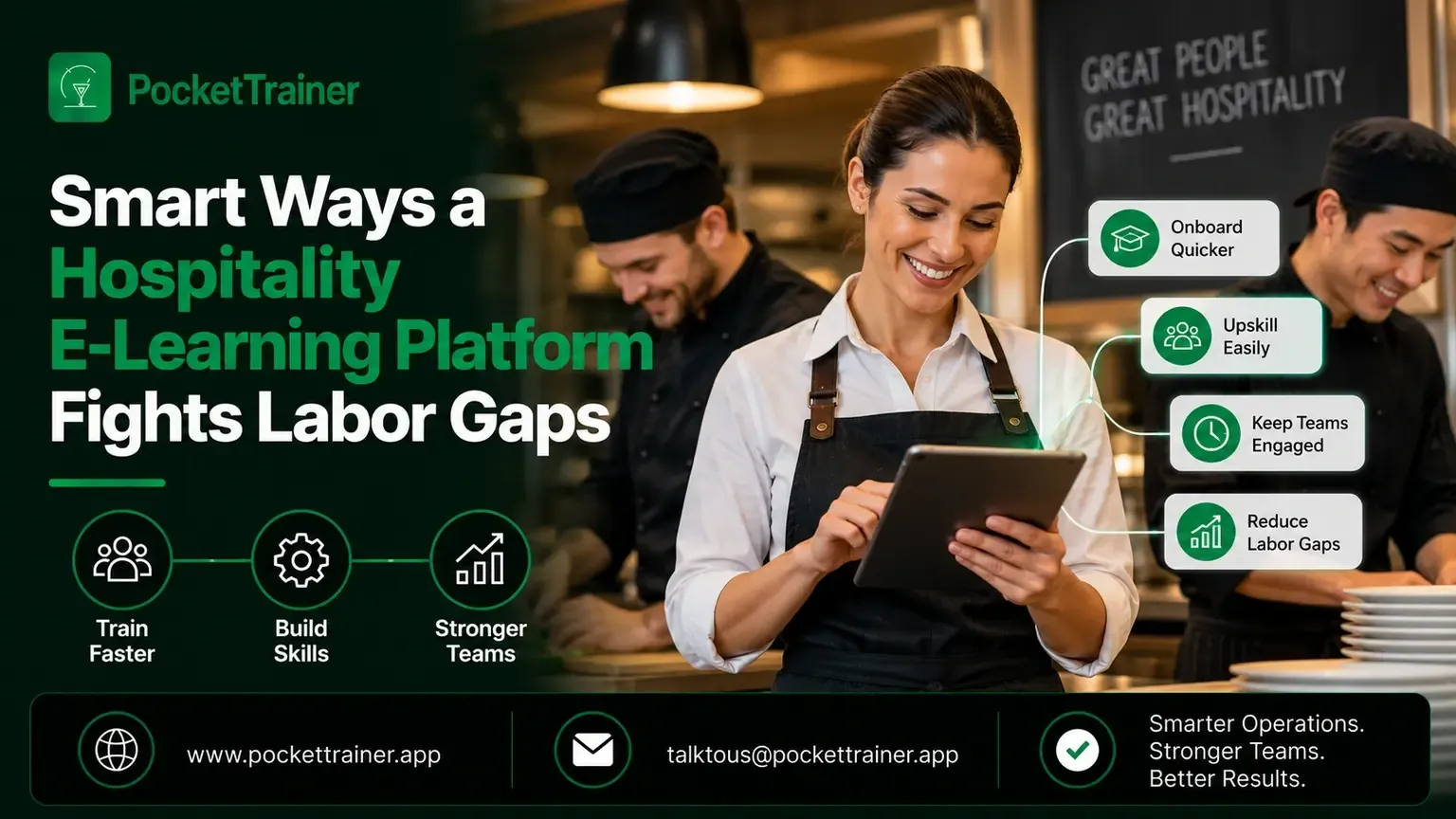
9 Smart Ways a Hospitality E-Learning Platform Fights Labor Gaps
By Janos Laszlo
- hospitality e-learning
- labour shortages
- staff training
- onboarding
- cross-training
Quick Summary
- Hospitality eLearning is online training built for venue teams: short sessions delivered on a phone, not the desktop-first, annually-updated model general corporate eLearning assumes.
- UK Hospitality reported over 100,000 vacancies across the sector in 2024, and the operators managing well are extracting more capacity from the team they have, not waiting for hiring to improve.
- Generic eLearning platforms fall short in a venue on four specific points: no structured home for a dish or drink, desktop-first design, reporting that can’t filter by site and role, and no room for your own standards.
- Done properly, hospitality eLearning compresses onboarding, enables cross-training without a classroom, and keeps knowledge from walking out the door with a leaver.
Hospitality staffing shortages are not a temporary problem. UK Hospitality reported over 100,000 vacancies across the sector in 2024, with the GCC facing similar structural challenges driven by high turnover and rapid expansion. Operators who are waiting for the labour market to improve are going to be waiting a long time.
The operators who are managing well are not doing it by hiring more people. They are doing it by extracting more operational capacity from the team they have. Hospitality eLearning is one of the primary tools making that possible, but only when it’s actually built for a venue, not adapted from a generic corporate platform. Here’s what it is, where the generic version falls short, and how it fights labour gaps in practice.
What Is Hospitality eLearning?
Hospitality eLearning is online training built for venue teams rather than for office workers, delivered in short sessions that fit around a shift and usually on a phone rather than a desktop. It typically covers compliance such as food safety and allergens, plus service standards, product knowledge, and onboarding. What separates it from general corporate eLearning is that the content changes weekly rather than annually, because a menu changes far more often than a policy does, and that the people using it rarely have a desk.
Where Generic eLearning Falls Short in a Venue
Generic eLearning platforms are built for office workers with a desk and a policy that rarely changes, which is precisely what a venue does not have.
Four gaps show up consistently once a hospitality operator actually tries to run a generic platform on the floor:
- No structured home for a dish or a drink. A menu item isn’t a document; it’s a photo, an allergen list, a prep spec, and a price, and generic platforms have nowhere to put that except a file upload.
- Desktop-first interfaces for people who do not sit down. A kitchen porter or a server checking training between covers needs something built for a phone screen, not a course window designed for a monitor.
- Completion reporting that cannot filter by site and by role. A multi-site operator asking “who’s trained on allergens at the Brighton site” needs an answer in seconds, not a manual export.
- Course libraries that cannot contain your own standards. A generic platform sells you its content. It rarely gives you a real way to build and maintain your own menu, SOPs, and brand standards inside the same system.
This is the actual differentiator between a platform that gets adopted and one that gets abandoned after the launch week.
How Does a Hospitality eLearning Platform Help With Labour Shortages?
A hospitality eLearning platform reduces the operational impact of staffing shortages by compressing onboarding time, enabling rapid cross-training, reducing the training burden on experienced staff, standardising knowledge so it does not walk out the door with a leaver, and maintaining compliance without pulling people off the floor for classroom sessions.
1. Onboarding in Days, Not Weeks
The gap between a new hire’s start date and the point where they are operationally useful is a direct cost. Every day a new starter is shadowing rather than contributing independently is a day the team is effectively one person short.
Structured mobile-first onboarding compresses this gap significantly. A new server who completes their food safety, allergen awareness, and menu knowledge modules before their first shift arrives ready to work rather than ready to shadow. A new kitchen porter who has completed fire safety and COSHH training on their phone before day one does not need to be pulled aside for an induction that takes a manager off the floor.
Pocket Trainer’s Food Safety For Restaurants Level 2 UK and Food Allergen Awareness For Restaurants UK courses can be assigned before the first shift and completed on a phone during the commute. The full hospitality courses library covers the rest of the compliance floor the same way.
2. Cross-Training Without the Classroom
When you are short-staffed, flexibility is the most valuable operational asset you have. A server who can cover the bar during a rush, a kitchen porter who can handle basic prep, a supervisor who understands every station- these are the people who absorb pressure without breaking service.
Building cross-training into a hospitality eLearning platform makes it systematic rather than ad hoc. Instead of relying on a senior team member to informally train someone on a new station when the opportunity arises, you assign a structured cross-training path that the team member completes in their own time. The knowledge transfer happens without taking anyone off the floor.
3. Reducing the Training Burden on Experienced Staff
In a short-staffed team, your best and most experienced people are disproportionately burdened. They are running service, covering gaps, and training new starters simultaneously. That combination accelerates burnout and is itself a driver of further turnover.
Self-directed eLearning removes the dependency on a senior team member to deliver training. A new starter who can learn independently, accessing structured modules rather than following someone around asking questions, frees the experienced team to focus on what they are actually being paid to do.
This also improves training quality. A module built by a subject matter expert, reviewed and updated regularly, is more consistent than training delivered verbally by whoever happened to be on shift.
4. Standardising Knowledge Before It Walks Out the Door
In a high-turnover environment, institutional knowledge is fragile. When your head bartender leaves, they take the cocktail spec, the closing routine, and three years of operational knowledge with them. When your most experienced server leaves, the table management approach they developed over two years disappears.
A hospitality eLearning platform that captures operational knowledge in structured modules means that knowledge survives turnover. The closing procedure is documented and assigned. The cocktail spec is a module, not a memory. The allergen protocol is a course, not a conversation.
Pocket Trainer’s Beer Mastery 101, Wine Knowledge 101, and General Spirit Knowledge courses preserve beverage knowledge that would otherwise leave with the team member who held it.
Want to see how Pocket Trainer helps operators retain operational knowledge across high-turnover teams?
Book a 15-minute demo5. Bringing Agency and Temporary Staff Up to Speed Quickly
During peak periods, events, or cover situations, operators frequently rely on agency staff or casual workers. These team members often arrive with limited knowledge of your specific operation, standards, and allergen protocols, and there is rarely time to run a full induction before service.
A platform that allows you to assign a short, focused onboarding path to a temporary team member, deliverable on their phone before their shift, dramatically reduces the risk of a service incident caused by someone who did not know your procedures.
6. Compliance Training That Fits Around Shifts
Compliance training in most restaurants happens in one of two ways: a long induction session that covers everything at once and retains nothing, or a scramble before an inspection where gaps are papered over rather than addressed.
Mobile eLearning makes a third approach possible: short compliance modules assigned on hire, completed in the team member’s own time, with automatic certificates of completion and refresher tracking. The training happens continuously rather than in blocks. Compliance evidence is always current rather than assembled under pressure.
For UK operators, this approach covers the requirements under the Food Safety Act 1990, the Food Information Regulations 2014, and the Regulatory Reform (Fire Safety) Order 2005 without a single classroom session.
7. Maintaining Service Standards With a Changing Team
In a high-turnover environment, the guest experience fluctuates with the team. The service is excellent when the experienced staff is on and inconsistent when the newer starters are covering. Guests notice. Reviews reflect it.
Standardised training delivered through a consistent platform reduces this fluctuation. When every team member, regardless of how long they have been there, has completed the same service standards course, the same complaint handling module, and the same menu knowledge training, the quality floor rises across the team.
Pocket Trainer’s WOW Service and Handling Customer Complaints courses give every team member the same foundation, regardless of when they joined.
8. Building Career Paths That Improve Retention
The most effective long-term response to labour shortages is reducing turnover. Operators who build visible progression paths inside their teams retain staff longer because team members can see where the job goes.
A hospitality eLearning platform that maps training to career milestones- server to shift leader, commis to chef de partie- creates a tangible progression system. Completing a module is not just a compliance exercise. It is a step toward a promotion, a salary increase, or a new responsibility.
Pocket Trainer’s Conducting A Performance Appraisal course supports managers in having the structured career conversations that make progression feel real rather than theoretical.
9. Freeing Manager Time for Operations
A manager who spends two hours a day on training administration, assigning courses, chasing completions, and filing paper certificates has two fewer hours for the floor. In a short-staffed operation, that is a significant loss.
Automated onboarding paths, deadline reminders, completion tracking, and digital certificates remove the administrative overhead from the manager entirely. The platform manages the training process. The manager manages the team.
Final Thoughts
Labour shortages are not going away. But their operational impact is manageable for operators who have built the right systems. Hospitality eLearning does not solve the hiring problem. It reduces the cost of it, by making new starters operational faster, making experienced staff more available, and making the knowledge your team holds less dependent on any one person staying.
Want to see how Pocket Trainer helps operators manage with the team they have?
Book a 15-minute demoFAQs
What’s the difference between hospitality eLearning and general corporate eLearning?
Hospitality eLearning is mobile-first, updated as often as a menu changes, and built to hold structured content like dishes, drinks, and allergen data. General corporate eLearning assumes a desk, a fixed policy that changes annually, and a course library that has nothing to say about a specific venue’s menu or standards.
Can hospitality eLearning actually reduce the impact of staff shortages?
Yes, by compressing onboarding time, enabling structured cross-training without a classroom, and preserving operational knowledge that would otherwise leave with a departing team member. It doesn’t solve the hiring problem, but it reduces how much a shortage costs operationally.
Why does completion reporting matter more in hospitality than in other industries?
A multi-site operator needs to know who is trained on what, at which venue, in seconds, whether for a compliance check, an inspection, or simply covering a shift. Generic platforms built for single-office use rarely support filtering by site and role, which becomes a real operational gap at scale.
Is mobile-first design actually necessary, or is it a nice-to-have?
For hospitality specifically, it’s necessary. Most hospitality staff, kitchen porters, servers, bartenders, never sit at a desk during their working day, so training built around a desktop interface simply doesn’t get completed.